
Golf Cart Policy Guide: What to Know
Golf carts have become common in neighborhoods, retirement communities, and golf courses across the country. But many owners don’t realize they need specific insurance coverage beyond what their homeowners policy provides.
At North Point Insurance Group, we’ve created this golf cart policy guide to help you understand your coverage options and protect yourself from liability risks. Whether you drive on public roads or private property, the right policy makes all the difference.
Golf Cart Coverage Types That Protect Your Investment
Liability Coverage: Your First Line of Defense
Liability coverage forms the foundation of any golf cart policy because it protects you when your cart causes injury or property damage to someone else. A passenger thrown from your cart and fracturing an arm, or your cart damaging a parked car-liability coverage handles the medical bills and repair costs. Florida and South Carolina both require liability insurance if you operate a golf cart on public roads, with Florida mandating at least $10,000 in property damage liability for street-legal low-speed vehicles. Standard golf cart liability policies typically start around $10,000 to $25,000 in coverage limits, though this varies by state and local ordinance.
The real risk emerges when a lawsuit exceeds your policy limit. Without adequate coverage, your personal assets become vulnerable to claims that far surpass what your policy pays out.
Collision and Comprehensive Coverage: Protecting Your Cart
Collision and comprehensive coverage protects your investment in the cart itself rather than third-party claims. Collision coverage pays for damage when your cart hits another vehicle or object, while comprehensive coverage handles theft, vandalism, flooding, and fire. New golf carts cost between $7,000 and $9,000, making these coverage types worthwhile for owners who financed their purchase or live in areas prone to theft or weather damage.
Many carriers allow you to bundle golf cart coverage with your homeowners or auto policy, but standalone golf cart policies typically offer broader protection since homeowners policies often exclude off-premise liability and medical costs for third-party injuries.
Medical Payments Coverage: An Often-Overlooked Essential
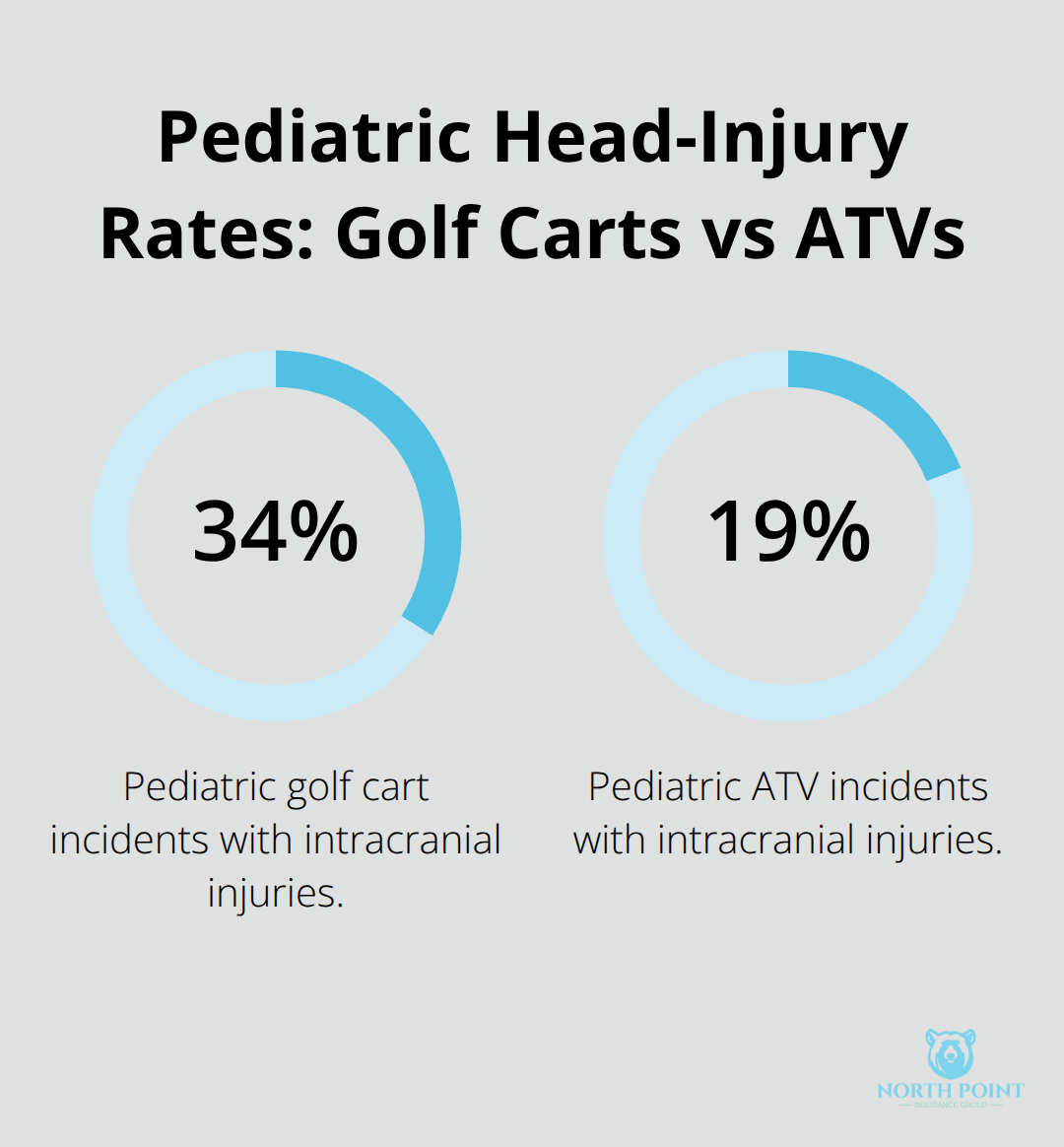
Medical payments coverage fills a critical gap by covering medical expenses for you and your passengers regardless of fault. A Florida multicenter study found that pediatric golf cart injuries resulted in intracranial injuries 34% of the time-substantially higher than ATV injuries at 19%-with more than 60% of children injured in golf cart incidents suffering a traumatic brain injury. This data underscores why medical payments coverage matters, especially if children ride in your cart.
Try medical payments limits of at least $1,000 to $5,000 per person when comparing policies.
Finding the Right Policy for Your Situation
Shop quotes from multiple carriers because premiums and coverage options vary significantly. A cart used only on private property carries lower premiums than one driven on public roads in multiple counties. Your usage patterns and risk factors directly influence both the coverage you need and what you’ll pay for it.
When You Need Golf Cart Insurance
Public Roads Require Mandatory Coverage
Public road operation transforms insurance from optional to mandatory. In Florida, if your golf cart qualifies as a street-legal low-speed vehicle, you must carry at least $10,000 in property damage liability and $10,000 in personal injury protection. South Carolina imposes registration and liability insurance requirements for any golf cart operated on public streets, with the additional constraint that you cannot venture more than 4 miles from your registration address.
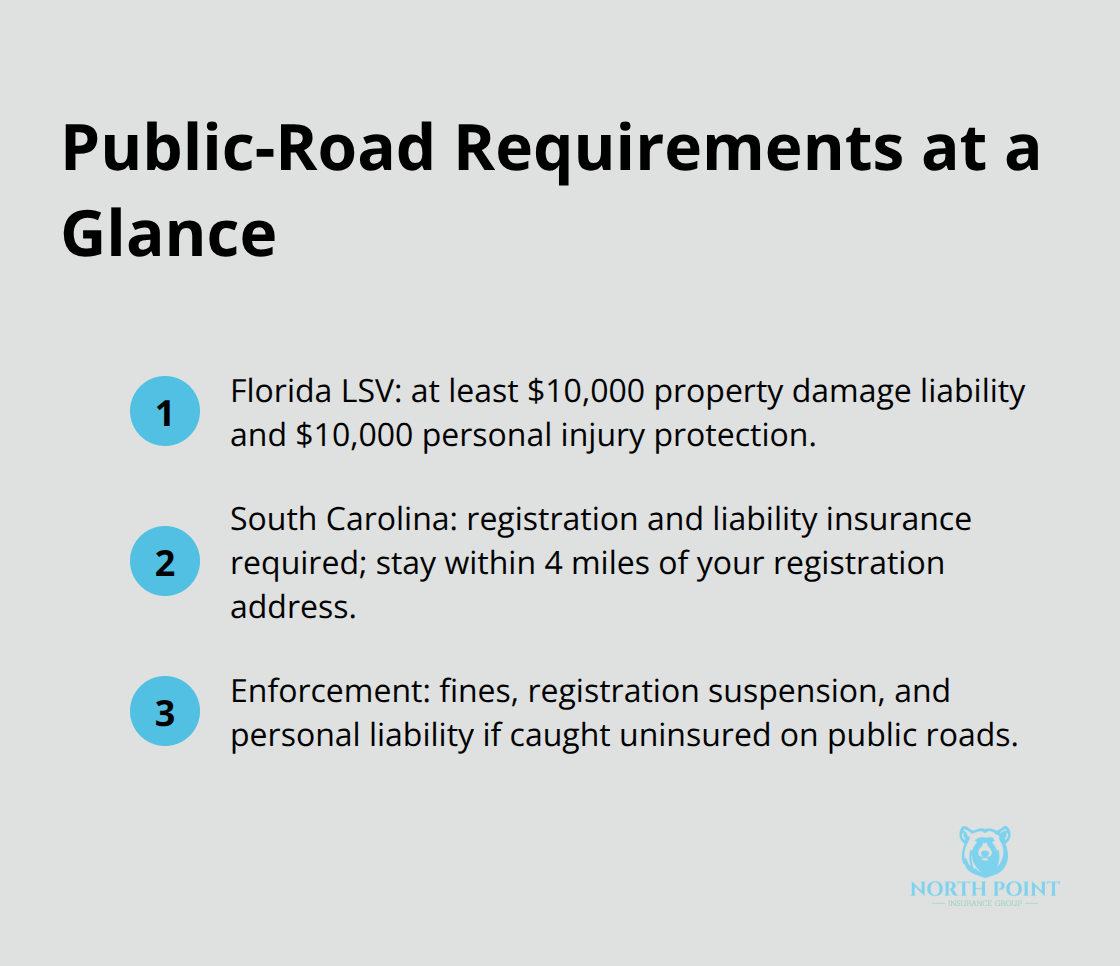
These aren’t suggestions-they’re legal requirements that state motor vehicle departments enforce. If authorities catch you uninsured on public roads, you face fines, registration suspension, and personal liability for any accidents.
The Insurance Research Council reported that Florida’s uninsured motorist rate reached 20.4% in 2019, meaning one in five drivers lacked coverage. Operating an uninsured golf cart puts you in that vulnerable position. A single incident involving another motorist could result in you covering their medical bills and vehicle repairs from your own pocket.
Local Ordinances Create Additional Requirements
Community rules and local ordinances frequently exceed state minimums, creating a patchwork of requirements that trip up owners who assume state law is sufficient. Many gated communities, homeowners associations, and municipalities require golf cart registration, proof of liability insurance, and specific safety equipment before you can legally operate on their roads. South Carolina’s May 2025 legal update specifically granted local jurisdictions authority to set their own operating hours, methods, and locations for golf carts (provided speed limits stay at 35 mph or less). This means your neighbor’s community might allow golf carts between 7 a.m. and 6 p.m., while the next development over permits operation until 9 p.m.
Contact your local municipality or HOA directly to confirm their specific requirements rather than relying on assumptions. What works in one neighborhood may violate rules in another.
Homeowners Insurance Falls Short
Standard homeowners policies exclude golf cart liability and medical payments coverage unless you purchase a rider or endorsement. Many homeowners policies also don’t cover your cart if you operate it outside your immediate community, and they typically exclude third-party injury claims. Adding your golf cart to your homeowners policy often provides inferior protection compared to a standalone golf cart policy, which explicitly covers medical expenses for passengers, liability from cart operation, and collision or comprehensive damage.
The gaps in homeowners coverage leave you exposed to significant financial risk. A dedicated golf cart policy addresses these shortcomings directly, offering protection tailored to how you actually use your cart. As you assess your specific situation-whether you drive on public roads, operate in multiple communities, or transport passengers regularly-the coverage gaps become clearer.
How to Choose the Right Golf Cart Policy
Document Your Actual Usage Patterns
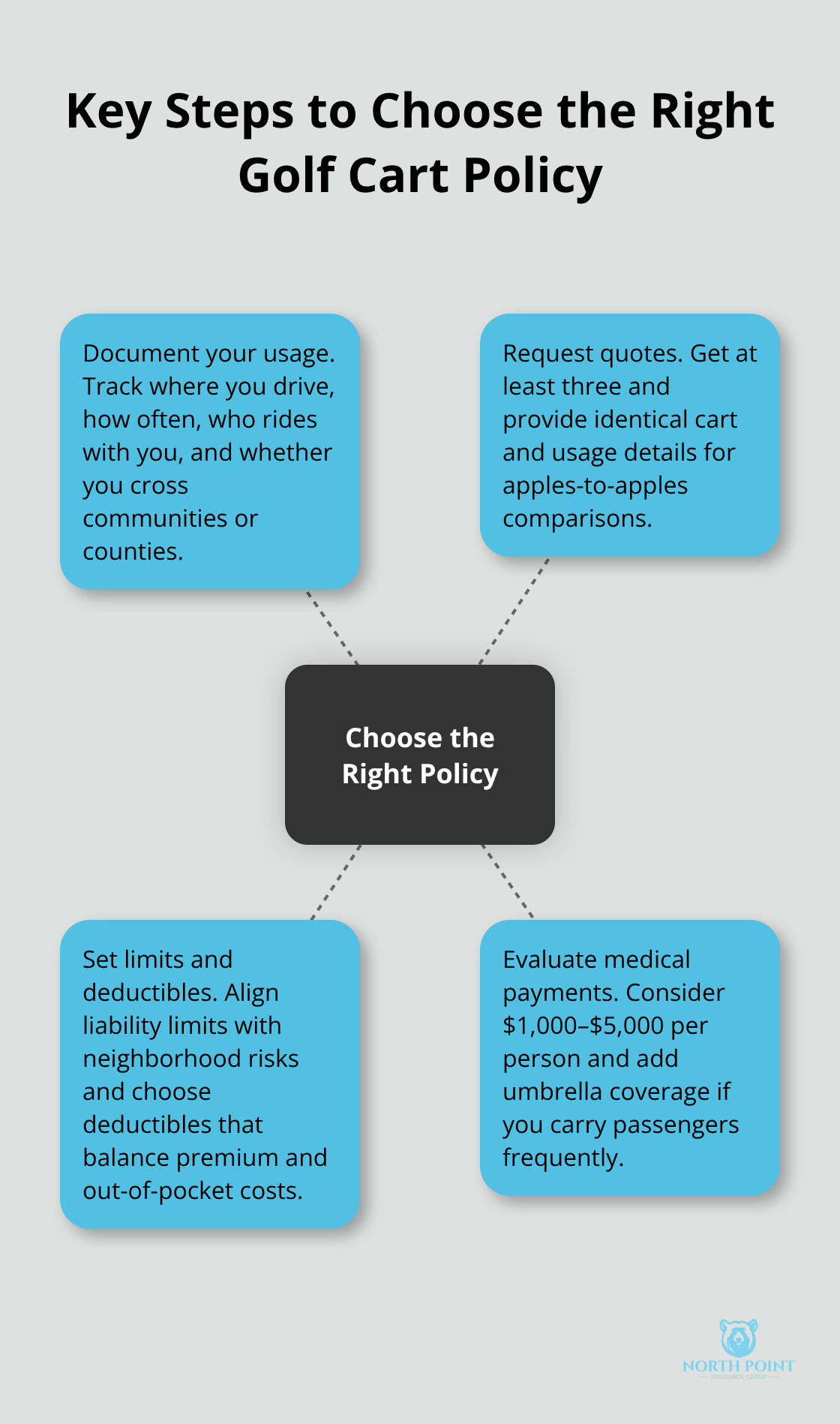
Start by recording exactly how you use your golf cart over a typical month. Track whether you operate on public roads or only private property, how many miles you drive weekly, who rides with you (children, elderly relatives, frequent guests), and whether you cross county lines or venture into multiple communities. This usage profile determines what coverage you genuinely need versus what sounds appealing but won’t apply to your situation. A cart that stays within a single gated community on private property requires far less coverage than one driven across public roads in South Carolina’s 4-mile registration radius or Florida’s designated roadways.
Insurance carriers price policies based on exposure, so accurately reporting your usage prevents overpaying for unnecessary coverage while ensuring you don’t underinsure and face gaps when an accident happens. Many owners mistakenly assume their risk is lower than it actually is, particularly when passengers ride regularly. The Florida multicenter study showing 34% of pediatric golf cart injuries involve intracranial trauma should shift your perspective if children or teenagers operate or ride in your cart.
Request Quotes from Multiple Carriers
Premiums vary substantially between insurers for identical coverage. Request quotes from at least three carriers rather than accepting the first offer, and provide each insurer with identical information about your cart’s age, make, model, usage patterns, and desired coverage limits to ensure accurate comparisons.
When comparing quotes, examine not just the premium but what each policy actually covers-some carriers exclude certain scenarios while others bundle coverage differently.
A policy that costs $50 less annually but excludes medical payments coverage for passengers isn’t a bargain if your teenager regularly rides with you. Document each quote’s liability limits, deductibles, and specific exclusions in a simple spreadsheet so you can see which carrier offers the best value for your actual needs. Shopping multiple carriers typically reveals $200 to $400 annual differences for comparable coverage-savings worth the effort of requesting quotes.
Set Liability Limits Based on Your Neighborhood
Standard policies often start at $10,000 liability limits, but this represents a floor, not a recommendation. If your cart damages a luxury vehicle or causes serious injury requiring ongoing medical care, $10,000 won’t cover the claim. Consider your neighborhood’s property values and the likelihood of high-cost medical scenarios when selecting liability limits.
Collision and comprehensive deductibles typically range from $250 to $1,000-higher deductibles lower your premium but mean you pay more out of pocket if damage occurs. For a $7,000 to $9,000 cart, a $500 deductible often strikes the right balance, keeping premiums reasonable while limiting your personal expense if you need to file a claim.
Evaluate Medical Payments Coverage Needs
Medical payments coverage limits of $1,000 to $5,000 per person protect against unexpected medical bills but won’t cover catastrophic injuries, so evaluate whether you need supplemental umbrella coverage if you frequently transport multiple passengers or operate on busier roads. This coverage becomes especially important when children ride in your cart, given the head-injury risks documented in pediatric trauma research.
Final Thoughts
Golf cart insurance transitions from optional to mandatory the moment you operate on public roads or in communities with specific requirements. Liability coverage shields you from claims that exceed your personal assets, while collision and comprehensive coverage protect the $7,000 to $9,000 investment in your cart. Medical payments coverage becomes essential when passengers ride with you, particularly children who face documented head-injury risks in golf cart incidents.
Your next step requires you to document your actual usage patterns, request quotes from multiple carriers, and compare coverage options side by side. State minimums often fall short of what your specific situation demands, and local ordinances in South Carolina, Florida, and your community frequently impose stricter requirements than state law allows. A golf cart policy guide helps you navigate these requirements, but your individual circumstances determine what coverage truly matters.
An independent agent simplifies this process considerably. At North Point Insurance Group, our local agents in Alpharetta, Georgia shop across 20+ carriers to find coverage that matches your needs and budget. Contact us today to discuss your golf cart coverage options and receive a quote that reflects your actual risk profile.
The information provided in this blog is for general informational purposes only and does not constitute legal, financial, or insurance advice. Coverage options, terms, and availability may vary. Please consult with a licensed professional for advice specific to your situation. Artificial intelligence may have been used to generate text and images in some blog articles and may contain inacuracies.

