

Best Auto Coverage Options: Which Policy Fits You
Picking the right auto insurance coverage feels overwhelming when you’re staring at liability limits, deductibles, and a dozen policy options. Most drivers either overpay for protection they don’t need or skimp on coverage that could save them thousands after an accident.
At North Point Insurance Group, we’ve helped countless customers find the best auto coverage options that match their actual situation. This guide walks you through the coverage types that matter, the factors that shape your needs, and how to avoid the mistakes that leave people underprotected or broke.
What Each Coverage Type Actually Protects
Liability Coverage: Your First Line of Defense
Liability coverage is where every driver must start, and it’s the one area where state minimums often fall short. Property damage liability pays for damage you cause to someone else’s vehicle or property, while bodily injury liability covers their medical bills and lost wages. Most states set minimums around 15/30 (meaning $15,000 per person and $30,000 per accident for bodily injury), but that’s dangerously low. A single serious injury can rack up $100,000 in medical costs within weeks, and if you’re found at fault, anything above your limit becomes your personal responsibility. Try 100/300 as a practical floor, though drivers with substantial assets should consider 250/500 or higher. The Insurance Information Institute notes that your liability limits should reflect what you could lose in a lawsuit, not just what your state requires.
Collision and Comprehensive: Protecting Your Vehicle
Collision coverage repairs or replaces your vehicle after an accident you cause or a crash regardless of fault, while comprehensive coverage handles everything else-theft, hail, fire, vandalism, animal strikes, and weather damage. The decision on whether to carry these hinges on your vehicle’s actual cash value. If your car is worth less than $4,000, you may drop collision and comprehensive since the premium you’d pay over several years might exceed the car’s replacement cost. For newer vehicles or financed cars, lenders typically require both, and that’s justified because repair costs are substantial. A fender-bender on a 2024 sedan easily costs $3,000 to $5,000 in repairs.
Deductible Strategy: Balancing Cost and Protection
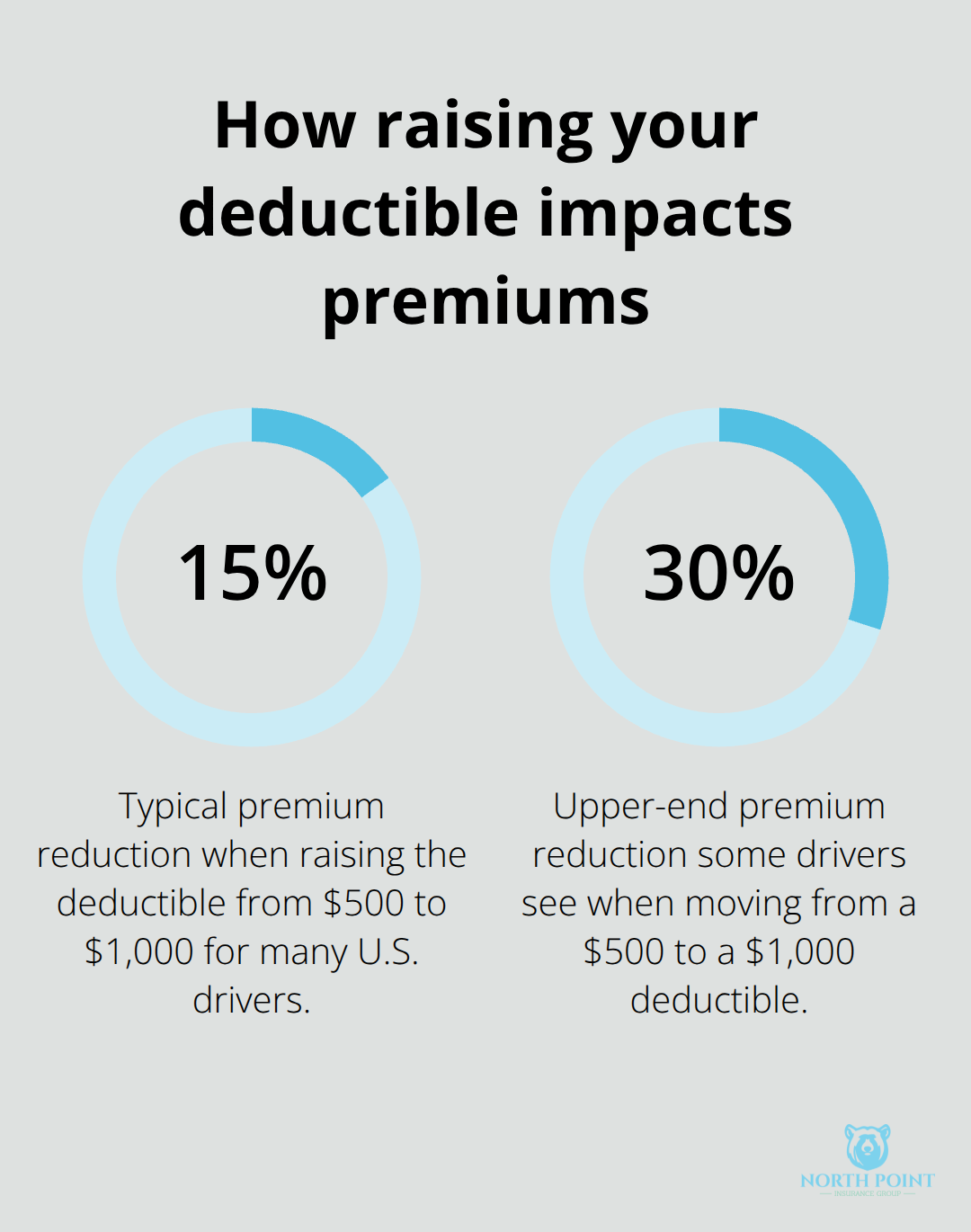
Set your deductible strategically to lower your premium without overextending yourself financially. Increasing your deductible from $500 to $1,000 typically cuts your premium by 15 to 30 percent, but only if you can actually pay that amount without financial strain after a claim. This trade-off works well for drivers with emergency savings, but it backfires for those living paycheck to paycheck.
Uninsured and Underinsured Motorist Coverage
Uninsured and underinsured motorist coverage fills a critical gap that most drivers overlook. If another driver causes an accident and has no insurance or insufficient coverage, this protection covers your medical bills, lost wages, and vehicle damage. It’s especially valuable in states with high uninsured driver rates and for drivers who commute in urban areas where hit-and-runs occur more frequently. This coverage becomes your safety net when the other party can’t pay, making it a smart addition to any policy.
Now that you understand what each coverage type protects, the next step is figuring out which ones you actually need based on your specific situation.
What Your Situation Actually Demands
Vehicle Age and Value Drive Coverage Decisions
Your vehicle’s age and value determine whether collision and comprehensive coverage makes financial sense. If your car is worth $4,000 or less, the annual premium for both coverages often exceeds what you’d collect in a claim, making these optional coverages wasteful. A financed 2023 vehicle with a $25,000 loan absolutely requires collision and comprehensive because your lender mandates it and repair costs justify the expense. A minor fender-bender on newer vehicles runs $3,000 to $5,000, so dropping coverage creates genuine risk.
Mileage and Commute Patterns Shape Your Risk
Your commute distance and driving patterns shape your exposure significantly. Someone driving 7,500 miles annually in suburban areas faces different risks than a commuter logging 25,000 miles on congested urban highways. The real factor is frequency of exposure to accidents.
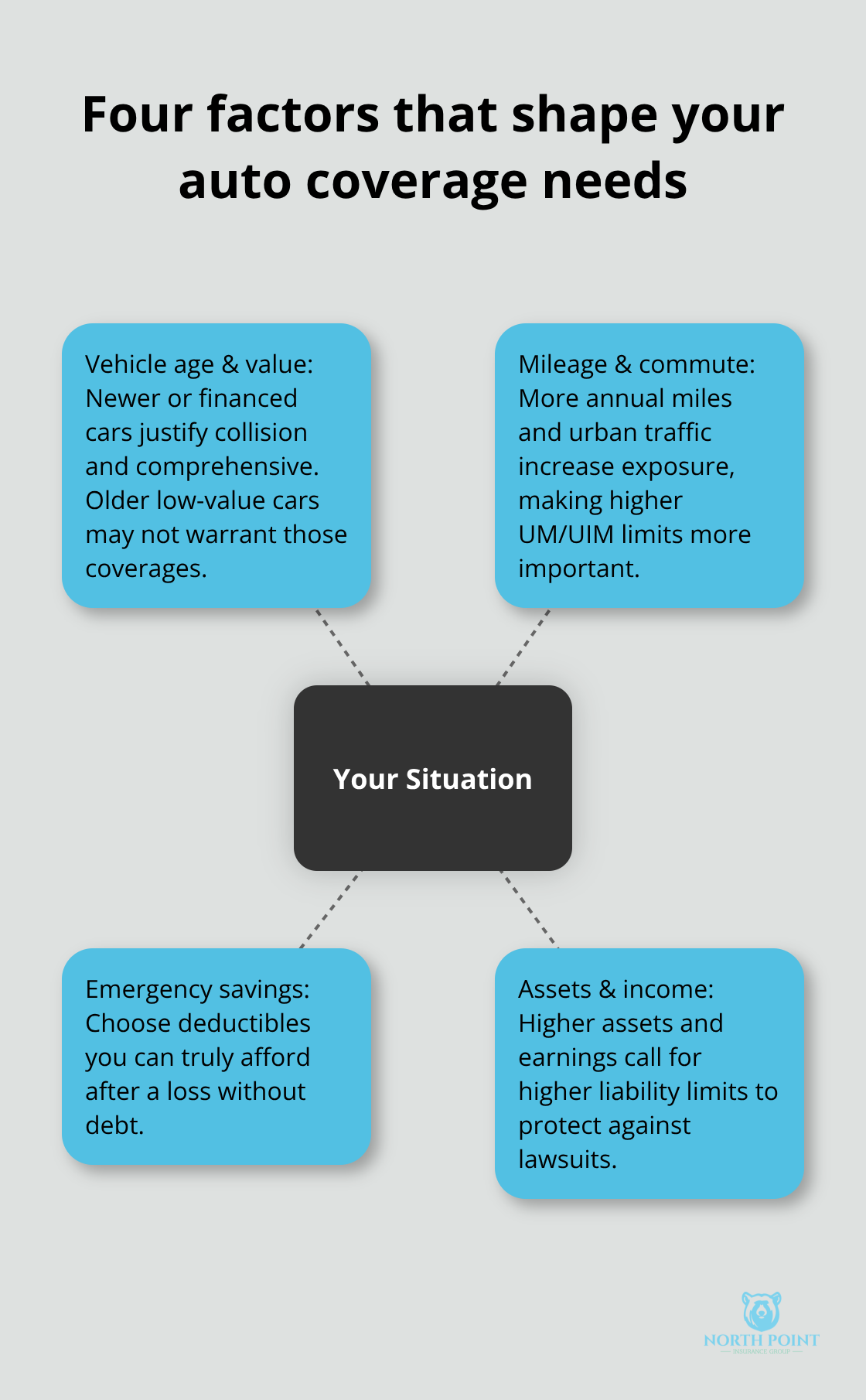
High-mileage urban drivers should maintain uninsured and underinsured motorist coverage at 100/300 or higher since they encounter more uninsured drivers and hit-and-run scenarios.
Emergency Savings Determine Your Deductible
Your financial capacity determines deductible choices more than anything else. If you have $2,000 in emergency savings, a $1,000 deductible is reasonable because you can absorb that cost without derailing your budget. If you live without a financial cushion, a $500 deductible protects you from making a claim that forces you into debt. The Insurance Information Institute emphasizes that deductible strategy only works when you can genuinely pay the amount after a loss. Raising your deductible from $500 to $1,000 typically cuts premiums 15 to 30 percent, but that savings vanishes if a claim forces you to finance the deductible on a credit card at 18 percent interest.
Assets and Income Determine Liability Limits
Your liability limits should reflect what you own and could lose. A driver with a home, retirement accounts, and substantial income should carry 250/500 liability limits or higher because a serious accident could expose personal assets to a lawsuit judgment. Someone renting an apartment with minimal assets can operate safely at 100/300, though 100/300 remains the minimum recommendation across the board since medical costs escalate quickly. Your risk tolerance matters less than your actual financial exposure-this isn’t about personality, it’s about math.
With these factors mapped to your specific circumstances, you’re ready to calculate the exact coverage amounts that protect you without leaving money on the table.
Calculating Coverage That Matches Your Real Exposure
Liability Limits Reflect What You Stand to Lose
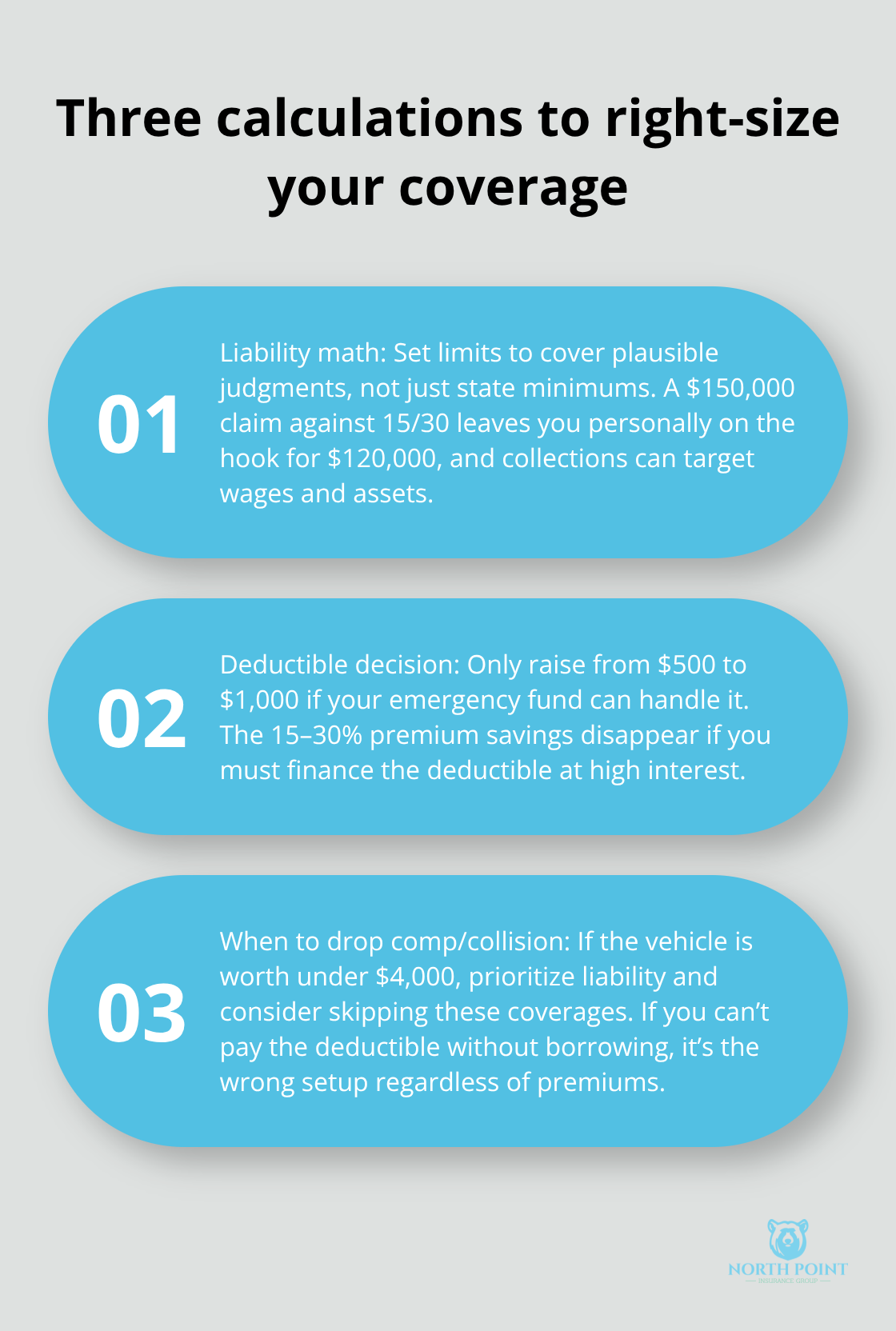
The math behind adequate liability coverage is straightforward once you stop thinking about state minimums and start thinking about actual risk. Your liability limits should cover what a court could award against you, not what feels comfortable. A single serious injury claim easily exceeds $100,000 in medical costs, lost wages, and pain-and-suffering damages. If you carry only your state’s minimum of 15/30 and face a $150,000 judgment, you’re personally liable for the remaining $120,000. That judgment can attach to your wages, bank accounts, and assets for years.
The Insurance Information Institute recommends 100/300 as a practical minimum for most drivers, meaning $100,000 per person and $300,000 per accident for bodily injury. Drivers with homes, retirement savings, or stable income should push to 250/500 because the extra premium is negligible compared to the protection gained. A $50 monthly difference between 100/300 and 250/500 coverage adds up to $600 annually, but it shields assets worth tens of thousands from a lawsuit.
Collision and Comprehensive Deductibles Demand Honest Assessment
Your deductible is purely a personal financial decision based on what you can actually pay after a loss. Raising your deductible from $500 to $1,000 typically cuts your collision and comprehensive premiums by 15 to 30 percent according to the Insurance Information Institute, but only choose this if your emergency fund can absorb a $1,000 claim payment without forcing you to carry credit card debt.
A driver with $3,000 in savings should stick with a $500 deductible because a $1,000 claim would wipe out most emergency reserves. Conversely, a driver with $10,000 in liquid savings benefits from the $1,000 deductible because the annual premium savings of $150 to $300 outweigh the higher out-of-pocket risk. The mistake most people make is choosing deductibles based on what sounds affordable rather than what their actual financial situation supports.
When to Skip Collision and Comprehensive Entirely
For older vehicles worth under $4,000, skip collision and comprehensive entirely and maintain solid liability coverage instead, which costs far less and protects you where you actually face financial exposure. If you can’t pay the deductible without borrowing money at interest, you’ve made the wrong choice regardless of the premium savings.
Final Thoughts
Your best auto coverage options depend on your vehicle’s value, your financial capacity, and what you stand to lose in a lawsuit. A 22-year-old with a financed 2024 sedan needs collision, comprehensive, and uninsured motorist coverage at solid limits because repair costs run steep and lenders require it. A 55-year-old with a paid-off 2015 Honda worth $8,000 and substantial home equity needs higher liability limits to protect those assets, but collision coverage becomes optional math rather than necessity.
Life changes fast, and your coverage needs shift with it. You buy a new car, move to a different state, get married, or your financial situation transforms. A policy that made perfect sense two years ago might leave you overprotected or underprotected now. Review your coverage annually and after major life events like purchasing a home, getting married, or changing jobs so your deductible strategy and liability limits stay aligned with your actual situation.
Getting this right matters too much to guess or rely on online calculators that don’t know your circumstances. At North Point Insurance Group, our local agents understand that coverage decisions are personal and financial, not one-size-fits-all. Contact North Point Insurance Group to get personalized guidance from agents who take time to understand your actual needs and help you find the best auto coverage options at competitive prices.
The information provided in this blog is for general informational purposes only and does not constitute legal, financial, or insurance advice. Coverage options, terms, and availability may vary. Please consult with a licensed professional for advice specific to your situation. Artificial intelligence may have been used to generate text and images in some blog articles and may contain inacuracies.

