

Auto Insurance Coverages Explained: What Every Policy Includes
Auto insurance can feel overwhelming with all its different coverages and options. Most drivers don’t fully understand what their policy actually covers, which can lead to costly gaps in protection.
We at North Point Insurance Group created this guide to break down auto insurance coverages explained in plain language. You’ll learn exactly what each coverage does and how to choose the right combination for your situation.
What Liability Coverage Actually Protects
Liability coverage confuses most people, and that confusion can cost you tens of thousands of dollars. Here’s the hard truth: liability coverage protects the other person, not you. If you cause an accident and injure someone or damage their property, your liability insurance pays for their medical bills, lost wages, and vehicle repairs. It does not pay for your own injuries or your own vehicle damage. That distinction matters when you review your policies.
Bodily injury liability covers injuries you cause to other people-medical expenses, lost income, pain and suffering, and legal fees if they sue. Property damage liability covers damage you cause to someone else’s vehicle, home, fence, or other property. California’s basic coverage requires bodily injury limits of $30,000 per person and $60,000 per accident, plus $15,000 in property damage liability. These minimums sound reasonable until you realize a serious crash involving multiple people or a newer vehicle can easily exceed these limits. A single hospitalization costs $100,000 or more. A newer luxury vehicle could be worth $50,000 to $100,000. If you’re found liable for injuries or damage beyond your policy limits, the other person can sue you personally and garnish your wages or seize your assets.
Your Liability Limits Should Match Your Net Worth
State minimums are dangerously low. If you have any meaningful assets-a house, savings, investments, a business-you should carry liability limits significantly higher than what your state requires. California’s standard coverage raises bodily injury to $100,000 per person and $300,000 per accident, with $50,000 in property damage. That’s a much better starting point, but it’s still not enough if you have substantial wealth.
Set your liability limits equal to or greater than your total net worth. If you own a home worth $400,000 and have $150,000 in savings and investments, your liability limit should be at least $550,000. Most insurers offer limits of $100,000, $250,000, $300,000, $500,000, and $1,000,000.
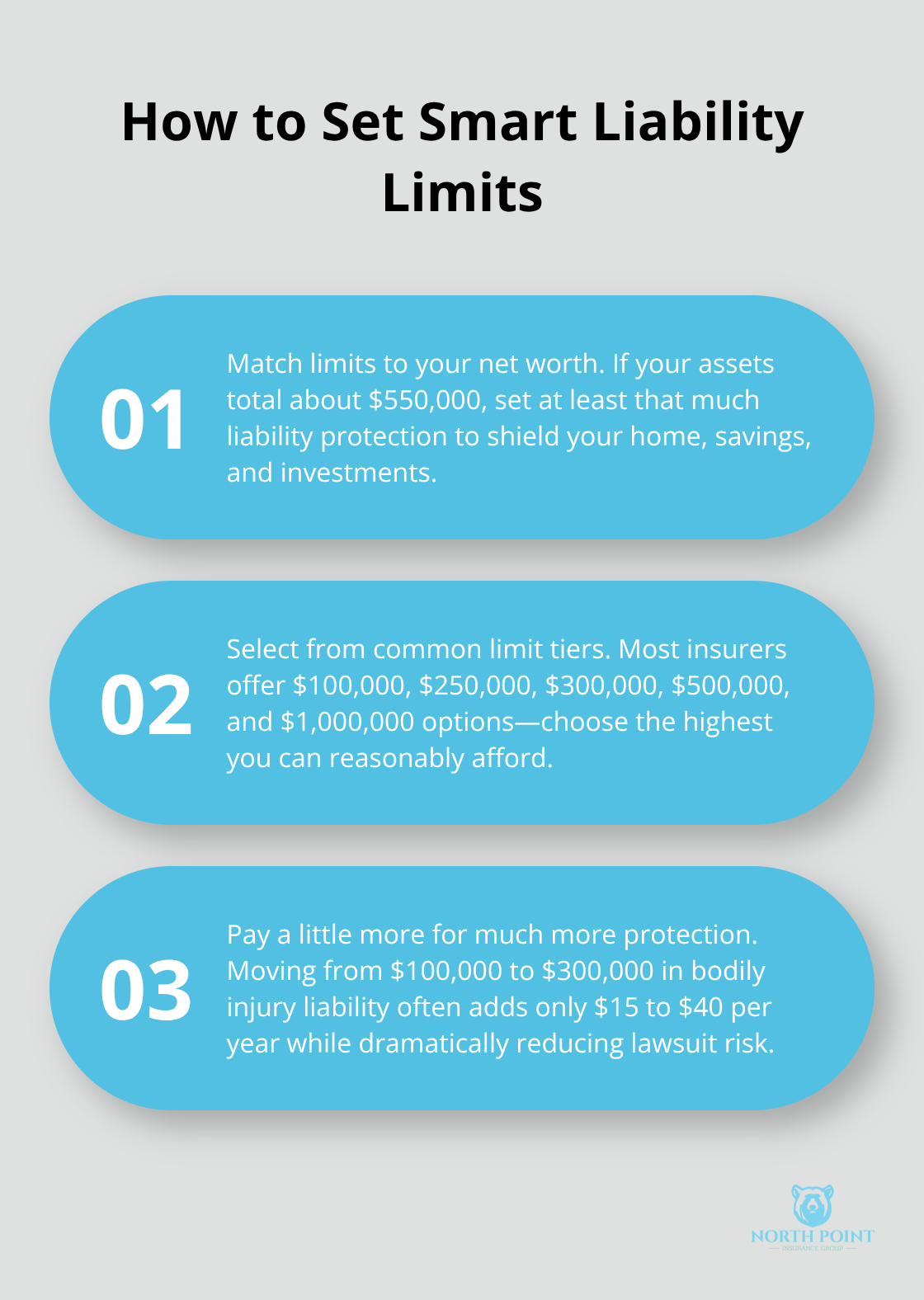
The premium difference between $100,000 and $300,000 in bodily injury liability is typically modest-often $15 to $40 per year depending on your location and driving history. That small increase in premium protects you against losing everything in a lawsuit.
Why Higher Limits Make Financial Sense
If you have assets worth protecting, an umbrella policy becomes essential. An umbrella policy sits on top of your auto and home liability coverage and activates when you exceed those limits. A $1,000,000 umbrella policy typically costs $150 to $300 annually and provides coverage above your auto and home liability limits. This combination-higher auto liability limits plus an umbrella policy-gives you real protection. Without it, a single serious accident wipes out years of financial progress.
The average personal injury lawsuit settlement exceeds $200,000, according to civil litigation studies. Add in property damage to multiple vehicles or a high-end car, and you’re looking at six figures quickly. The cost of defending yourself in court alone reaches $50,000 to $100,000. Your liability coverage pays for that legal defense, but only up to your policy limits. If you’re sued for damages beyond your limits and lack an umbrella policy, you’re personally responsible for the difference.
What Happens When Liability Limits Aren’t Enough
A real-world scenario illustrates the risk. You cause a multi-car accident on a highway. Three people suffer serious injuries requiring surgery and months of rehabilitation. One person’s medical bills total $250,000. Another person’s lost wages and pain and suffering claims reach $150,000. The third person settles for $100,000. You’ve now exceeded a $300,000 liability limit by $200,000. Without an umbrella policy, you owe that $200,000 out of pocket. The other drivers’ attorneys can pursue wage garnishment, place liens on your home, or seize your bank accounts. That’s why liability limits matter far more than most drivers realize.
Your next step involves understanding what happens when damage occurs to your own vehicle-that’s where collision and comprehensive coverage enter the picture.
Protecting Your Vehicle When Accidents and Disasters Strike
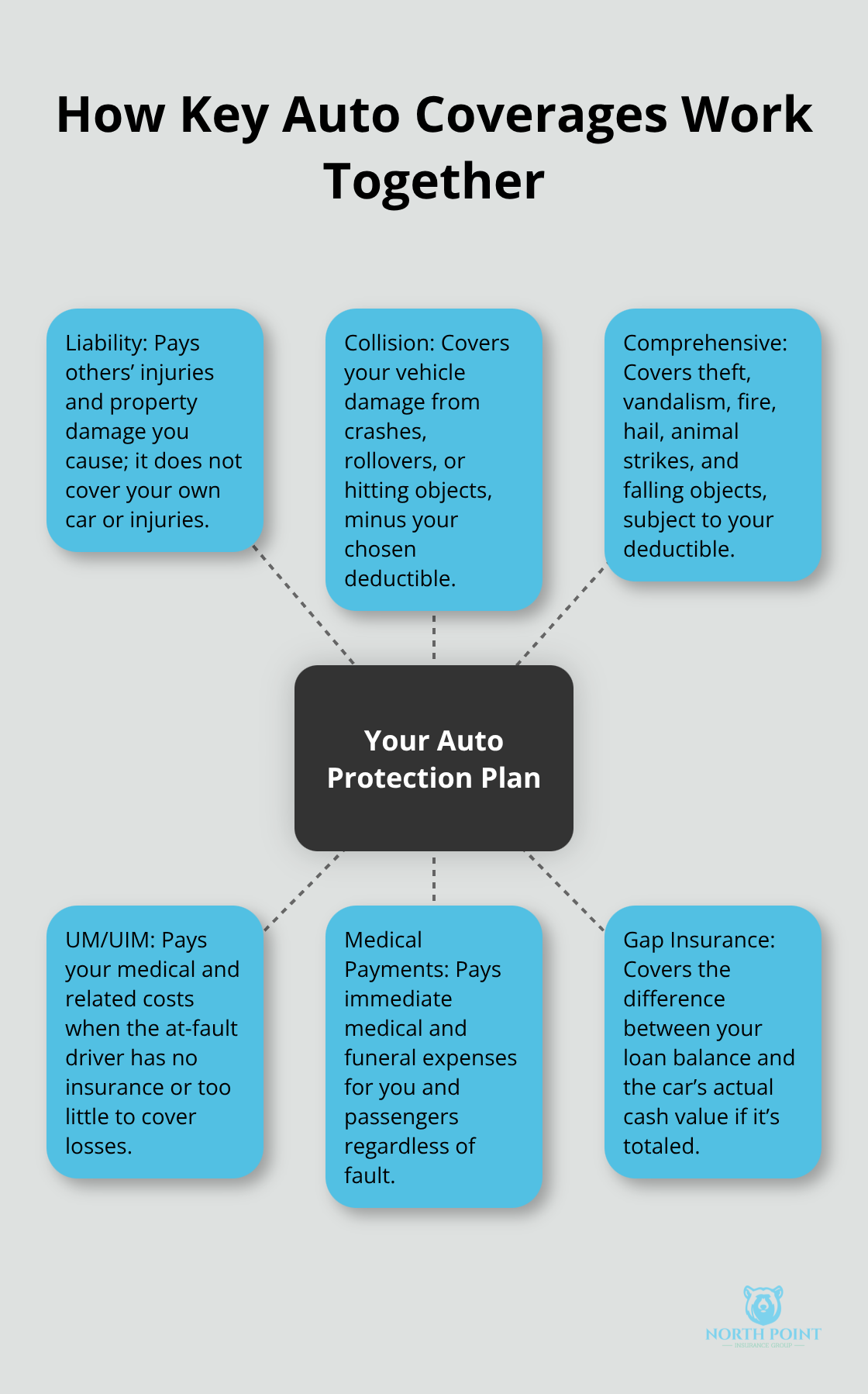
Collision and comprehensive coverage protect your own vehicle, which is fundamentally different from liability coverage. Liability pays for damage you cause to others. Collision and comprehensive pay for damage to your car regardless of fault. If you financed or leased your vehicle, your lender requires both coverages. If you own your car outright, these coverages are optional by law, but skipping them is a financial mistake unless your vehicle is worth less than a few hundred dollars.
Collision coverage pays for physical damage when your car hits another vehicle, a pole, a guardrail, or flips over. Comprehensive coverage handles everything else-theft, vandalism, hail, fire, falling tree branches, animal collisions, and weather events. Neither coverage is legally mandated by any state, but that doesn’t mean you should ignore them. The average cost of collision repair exceeds $3,500 according to industry data, and comprehensive claims average $1,200 to $2,500 depending on the damage type. Without these coverages, one accident or theft wipes out months of income for most households.
Deductibles Control Your Out-of-Pocket Risk
Your deductible is what you pay before insurance kicks in, and this choice directly impacts both your premium and your financial exposure. California’s standard coverage offers a $250 comprehensive deductible and $500 collision deductible as baselines, but you can choose higher deductibles like $750, $1,000, or even $2,500. Raising your collision deductible from $500 to $1,000 typically saves $100 to $200 annually in premiums.
That sounds good until your car needs a $3,000 repair. Now you pay $1,000 out of pocket instead of $500, and you only saved $150 per year. You need to go five years without a collision claim to break even on that deductible increase.
Set your deductible equal to the amount you can actually afford to pay immediately if your car is damaged. If you have $750 in emergency savings, set a $750 deductible. If you have $2,000 available, set it to $2,000. Don’t let premium savings tempt you into choosing a deductible you can’t afford.
When Your Vehicle Becomes a Total Loss
The maximum payout for collision or comprehensive equals your vehicle’s actual cash value minus your deductible. If your car is worth $15,000 and you total it with a $500 collision deductible, the insurance company pays $14,500. That’s the cap. If you owe $16,000 on a loan, you’re $1,500 short and still owe the lender that difference. This gap between what you owe and what the car is worth creates serious financial risk, especially with newer vehicles that depreciate rapidly.
Gap insurance solves this problem by covering the difference between your loan balance and the vehicle’s actual cash value if it’s totaled. Gap insurance typically costs $15 to $30 annually and becomes essential if you’re financing a new car or rolling negative equity into a new loan. Used vehicles depreciate slower, so gap insurance matters less once your vehicle is three to four years old and worth more than you owe.
Understanding Coverage Limits and Real-World Costs
Comprehensive coverage generally costs less than collision, though exact price differences depend on your insurer, location, and car value. Both coverages protect your vehicle from physical damage, and you should assess your budget and risk tolerance to decide coverage levels. If you lease or finance your car, verify whether your loan requires both comprehensive and collision-most lenders do.
The financial stakes become clear when you face actual damage. A hail storm damages your roof and hood, triggering a $2,400 comprehensive claim. With a $250 deductible, you pay $250 and insurance covers $2,150. With a $1,000 deductible, you pay $1,000 and insurance covers $1,400. That $750 difference in out-of-pocket cost matters far more than the $50 to $100 you might save annually on premiums.
Now that you understand how collision and comprehensive protect your vehicle, you need to explore the additional coverages that fill critical gaps in your protection-especially when the other driver lacks adequate insurance.
What Protects You When the Other Driver Has No Insurance
Uninsured and Underinsured Motorist Coverage Fills a Critical Gap
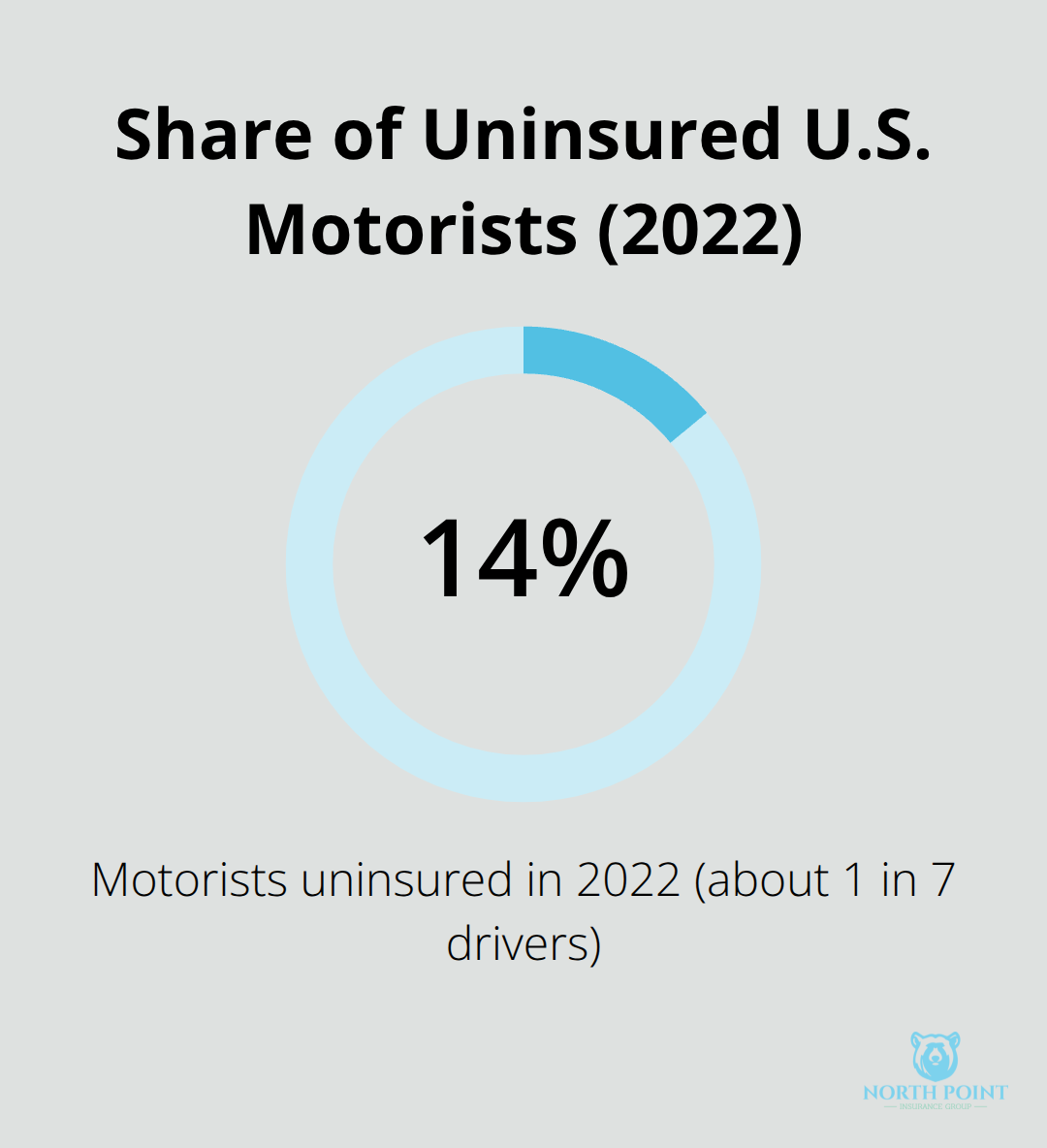
Roughly half of drivers on the road carry either no insurance or limits far too low to cover serious injuries. In 2022, 14.0 percent of motorists, or about one in seven drivers, were uninsured, though some states exceed 25%. When an uninsured driver hits you and causes $50,000 in medical expenses and vehicle damage, their lack of insurance becomes your financial disaster without proper protection.
Uninsured motorist bodily injury coverage pays your medical bills, lost wages, and pain and suffering when an uninsured or hit-and-run driver injures you or your passengers. Underinsured motorist coverage activates when the at-fault driver has insurance but their limits fall short of your actual damages. California’s basic coverage includes uninsured and underinsured motorist bodily injury limits of $30,000 per person and $60,000 per accident-the same minimums as liability coverage. That’s inadequate.
Why Minimum UM/UIM Limits Leave You Exposed
If an uninsured driver hits you and causes injuries requiring $100,000 in treatment, a $30,000 UM limit leaves you $70,000 short. You cannot sue the other driver successfully if they have no assets, so you’re stuck covering the gap yourself.
Raising your UM/UIM limits to $100,000 per person and $300,000 per accident costs little more than keeping minimums, typically adding just $20 to $50 annually to your premium depending on your location and vehicle.
This modest premium increase provides substantial protection. A serious accident involving multiple injuries or extended rehabilitation can easily exceed $100,000 in total costs. Your UM/UIM coverage pays these expenses up to your policy limit, protecting your savings and assets from being depleted by someone else’s irresponsibility.
Medical Payments Coverage Handles Immediate Treatment Costs
Medical payments coverage operates separately and pays for immediate medical and funeral expenses for you and your passengers after any accident, regardless of who caused it. Unlike UM/UIM coverage, medical payments doesn’t require proving the other driver was at fault or uninsured-it simply covers treatment costs up to your policy limit.
California’s basic coverage includes $2,000 in medical payments protection; standard coverage raises this to $30,000 per person and $60,000 per accident. Medical payments coverage proves particularly valuable if you lack comprehensive health insurance or face high deductibles on your health plan. A $2,000 medical payment limit barely covers an ambulance ride and initial emergency room treatment. Raising medical payments to $10,000 or $30,000 adds minimal cost but covers emergency care, follow-up treatment, and rehabilitation without forcing you to file claims against your health insurance first.
Try matching your medical payments limit to the deductible on your health insurance plan, so you have immediate coverage for out-of-pocket costs while your health insurance processes claims.
Uninsured Motorist Property Damage Protects Your Vehicle
Uninsured motorist property damage coverage handles damage to your vehicle when an uninsured driver hits you. This coverage pays for repairs up to your vehicle’s actual cash value, protecting you from the collision deductible you’d otherwise pay out of pocket. Without uninsured motorist property damage, an uninsured driver’s $40,000 vehicle damages your $25,000 car, and you pay your collision deductible while their lack of insurance goes unpunished.
Uninsured motorist property damage typically costs $5 to $15 annually and deserves inclusion on every policy, especially if you drive in areas with high rates of uninsured motorists. This low-cost coverage prevents a single encounter with an uninsured driver from creating unexpected out-of-pocket expenses on top of the inconvenience of vehicle repairs.
Final Thoughts
The coverage decisions you make today directly determine your financial protection tomorrow. Auto insurance coverages explained throughout this guide show that state minimums leave dangerous gaps-a single serious injury costs $100,000 or more in medical care and lost wages, yet California requires only $30,000 in bodily injury liability per person. That gap between what your policy covers and what you actually owe becomes your personal liability.
Your vehicle’s value and your financial situation should drive every coverage choice. If you own a $35,000 car with a $20,000 loan balance, skipping collision and comprehensive coverage means one accident or theft wipes out your equity and leaves you owing money on a destroyed vehicle. If you have $500,000 in home equity and investments, state minimum liability limits of $60,000 per accident expose your assets to seizure in a lawsuit.
Bodily injury liability should reach $100,000 per person and $300,000 per accident, uninsured motorist coverage should match those limits since one in seven drivers carries no insurance, and collision and comprehensive deductibles should reflect what you can actually afford to pay immediately. Contact us at North Point Insurance Group to review your current coverage and ensure you’re protected against the real financial risks you face on the road.
The information provided in this blog is for general informational purposes only and does not constitute legal, financial, or insurance advice. Coverage options, terms, and availability may vary. Please consult with a licensed professional for advice specific to your situation. Artificial intelligence may have been used to generate text and images in some blog articles and may contain inacuracies.

