

Boat Policy Options: A Practical Guide to Coverage
Boat owners face real decisions about what coverage actually protects them on the water. The right boat policy options can mean the difference between a manageable claim and financial hardship.
At North Point Insurance Group, we’ve helped countless boat owners navigate these choices. This guide walks you through the coverage types, rate factors, and selection process you need to make an informed decision.
What Coverage Do You Actually Need on the Water
Liability Coverage: Your First Line of Defense
Liability coverage is non-negotiable, and here’s why: one accident can expose you to six-figure claims. If your boat hits another vessel, injures a passenger, or damages a dock, liability coverage pays for damages and injuries you’re legally responsible for. Most states don’t legally require boat insurance, but lenders absolutely do-and they require liability as the baseline.
The standard liability limit starts around $100,000 per person and $300,000 per accident, but many experienced boaters recommend higher limits, especially if you operate in busy waterways or carry passengers regularly. Uninsured boater coverage protects you when the other boater has insufficient or no insurance. If you’re hit by an uninsured boater, this coverage reimburses you and your passengers for injuries up to your policy limits.
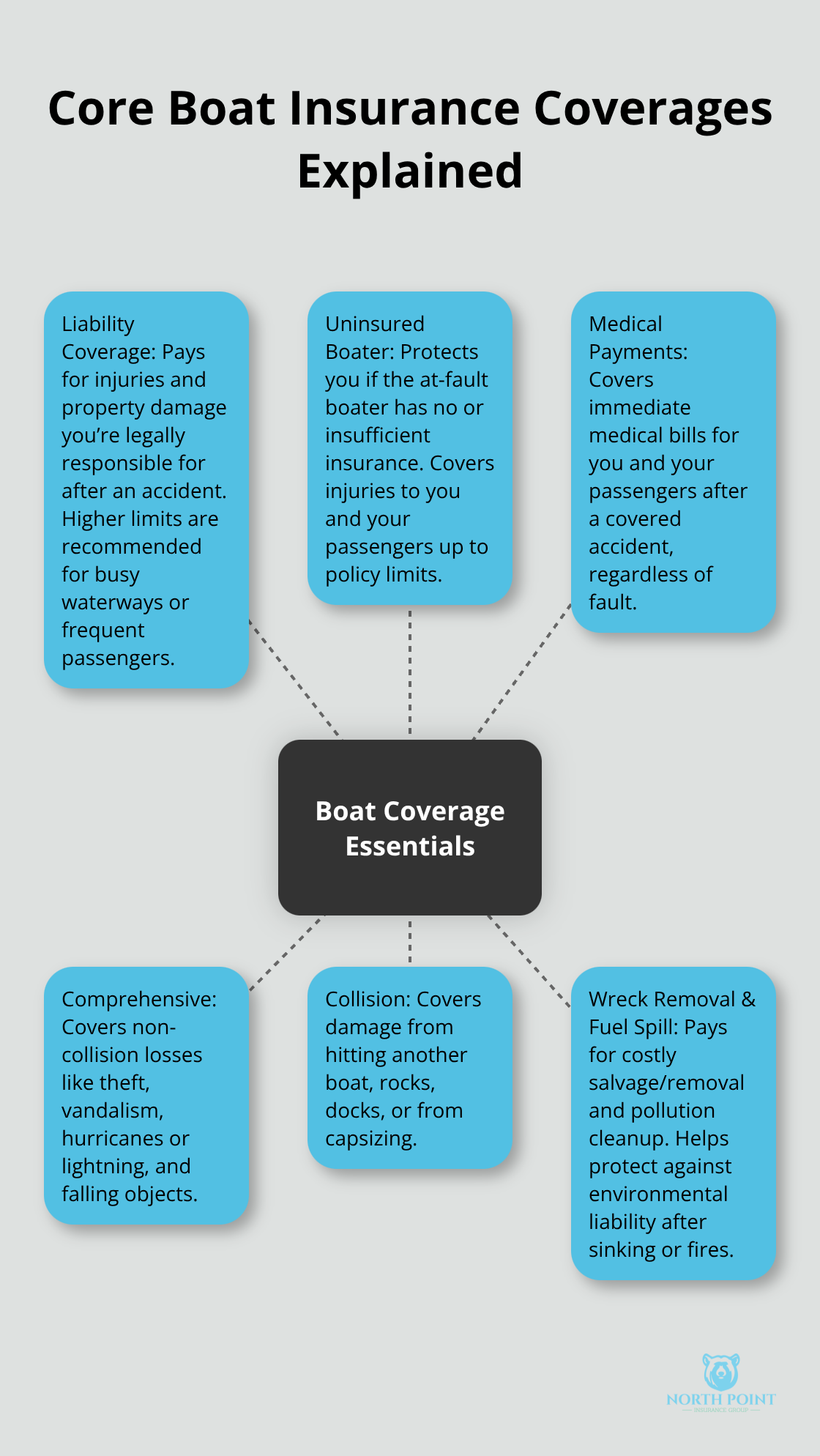
Medical payments coverage handles immediate medical bills for you and your passengers after a covered accident, regardless of fault. For a $50,000 boat, liability-only policies cost roughly $250 to $400 annually, making it the most affordable option for boats owned outright.
Comprehensive and Collision Coverage: Protecting Your Vessel
Comprehensive and collision coverage protects your actual vessel, and the difference matters significantly. Comprehensive covers non-collision damage from theft, vandalism, weather events like hurricanes or lightning, and falling objects-basically everything except hitting something. Collision covers damage from hitting other boats, rocks, docks, or even capsizing.
If your boat is financed, your lender will require both, often called full coverage. The annual premium for comprehensive and collision combined typically runs 1.5% of your boat’s purchase price, so roughly $750 for that $50,000 vessel. Deductibles commonly range from 1% to 5% of insured value, and choosing a higher deductible directly lowers your premium. If you’re financing, expect your lender to dictate minimum coverage amounts.
Critical Add-Ons Many Boat Owners Overlook
One critical add-on many boat owners skip is wreck removal and fuel spill liability coverage. If your boat sinks or catches fire, salvage and removal costs can exceed $10,000 without this rider. Additional fuel spill liability covers cleanup costs and third-party environmental damage from oil or fuel discharges, protecting you from federal and state environmental law violations.
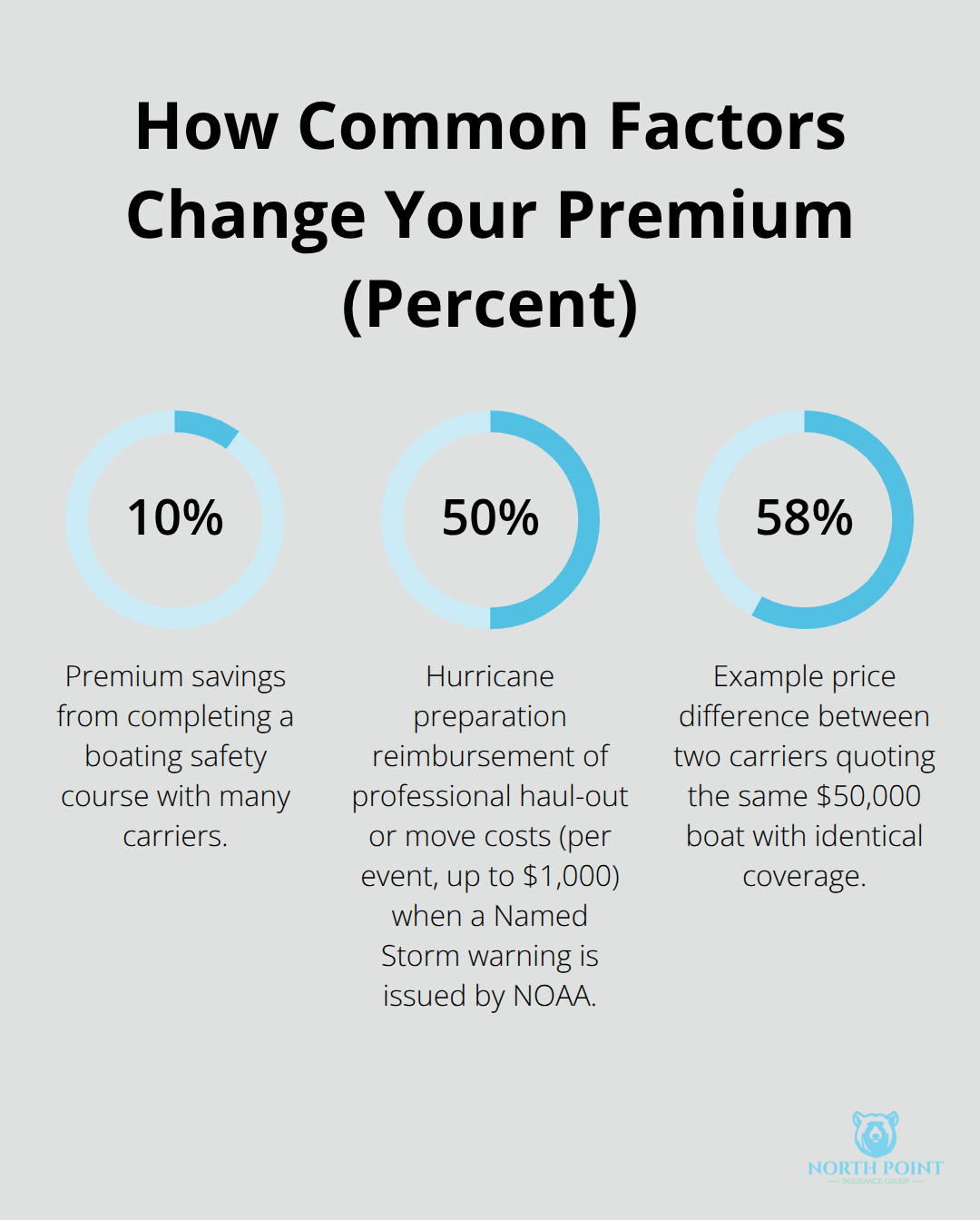
For boats in hurricane zones, confirm your policy includes hurricane preparation coverage-some insurers reimburse 50% of professional haul-out or move costs up to $1,000 per event when NOAA issues a Named Storm warning. These add-ons transform a basic policy into real protection when disasters strike.
Understanding what coverage you need sets the foundation, but your actual rates depend on factors specific to your boat and boating habits. The next section walks you through the rate determinants that insurers evaluate when they quote your policy.
What Drives Your Boat Insurance Premium
Insurers don’t charge everyone the same rate, and understanding why matters when you’re shopping for quotes. Your boat’s characteristics, your history on the water, and where you keep your vessel are the three primary factors that determine what you’ll pay annually.
Boat Type, Age, and Value Shape Your Base Rate
Boat age stands out as one of the biggest cost drivers-a 20-year-old boat costs significantly more to insure than a 5-year-old model of the same size because older hulls face higher failure rates and repair costs. Boat length and type matter equally; a 35-foot cabin cruiser costs more to insure than a 20-foot open runabout because the larger vessel carries higher liability exposure and replacement value. Power boats typically cost more than sailboats due to higher accident rates, and specialty boats like jet skis or high-performance vessels attract premium surcharges.
Your boat’s value directly influences premiums-a $50,000 vessel generates roughly $750 annually in comprehensive and collision costs at the standard 1.5% rate, while a $100,000 boat would run approximately $1,500 for the same coverage. Deductible choices compress or expand these numbers significantly; jumping from a 1% deductible to a 5% deductible can reduce your annual premium by 15% to 25%, though you’ll absorb more cost out-of-pocket when claims happen.
Your Experience and Claims History Determine Risk Assessment
Your boating experience and track record directly influence what carriers will quote you. Completing a boating safety course saves money on premiums with many insurers, making a weekend safety certification one of the fastest ways to lower costs. Previous claims tell insurers whether you operate carefully-one accident claim can increase rates by 20% to 40% for three to five years, while multiple claims within a five-year window may cause carriers to decline coverage entirely.
First-time boat owners often pay higher rates than experienced boaters with clean records because insurers view inexperience as higher risk. Your driving record and claims history on auto policies also factor into boat insurance underwriting; carriers cross-check your overall insurance profile to assess risk patterns. Age matters too-boaters under 25 typically face rate increases, while boaters over 65 may see modest increases depending on the carrier’s underwriting guidelines.
Location and Storage Exposure Affect Your Premium
Where you keep your boat and where you operate it directly affects your premium. Boats moored in hurricane zones like Florida, coastal Louisiana, or the Gulf Coast face substantially higher rates-sometimes 30% to 50% more than boats in inland lakes-because weather exposure is quantifiable and predictable. Boats stored on land in a covered structure cost less to insure than boats left exposed to weather or kept in high-theft marina areas.
Navigation area restrictions reduce premiums if you limit cruising to inland lakes or rivers rather than coastal waters; operating strictly within 50 miles of your home port costs less than unrestricted ocean access. Marinas in high-crime areas or areas with frequent theft reports drive up comprehensive coverage costs. Winter storage and lay-up periods create opportunities for premium reductions; if you haul out your boat for four months annually, you can negotiate lay-up discounts that lower your yearly cost by 10% to 15%. The specific mooring location matters-a private dock at your home typically costs less to insure than a commercial marina slip because theft and vandalism risk is lower.
How to Lower Your Premium Through Smart Choices
Multiple factors work together to shape your final rate. Installing safety devices (automatic engine fire suppression, bilge detectors, anti-theft alarms or trackers) can earn premium credits with many carriers. Owning multiple boat policies or holding auto insurance with the same company can unlock additional discounts. Shopping quotes from multiple insurers reveals significant price variations-two carriers may quote the same boat at $600 and $900 annually for identical coverage, making comparison essential.
Your rate reflects real risk, but you control several levers. The decisions you make about coverage limits, deductibles, and where you operate your boat directly translate to what you pay. Once you understand what drives your premium, the next step involves selecting the right coverage combination for your specific boat and boating habits.
Matching Coverage to Your Boat and How You Use It
Assess Your Boat’s Purpose and Operating Patterns
Your boat’s purpose and how often you operate it should drive every coverage decision you make. A 16-foot fishing boat used on inland lakes requires fundamentally different protection than a 35-foot cabin cruiser that crosses open water and carries passengers regularly. Start by documenting your actual boating patterns: the waterways you navigate, how many days annually you operate, whether you carry passengers for free or compensation, and what equipment stays aboard. This inventory becomes your baseline for comparing quotes.
A boat that runs inland only needs different liability limits than a coastal cruiser exposed to ocean conditions. If you fish occasionally on a local reservoir, liability-only coverage might suffice and save you money compared to full coverage. But if you host regular gatherings with guests or operate in busy marina areas, the liability exposure climbs dramatically, and skipping comprehensive or collision coverage becomes financially reckless.
Owned Versus Financed Boats: Coverage Requirements Differ
The key distinction separates boats you own outright from financed vessels. Lenders demand comprehensive and collision coverage regardless of your preferences, removing the choice equation entirely. For owned boats, your net worth and risk tolerance determine the threshold. If losing your boat would strain your finances, full coverage makes sense. If you can absorb the loss, liability-only or liability plus comprehensive (without collision) becomes viable.
Many boat owners underestimate their liability exposure; a single serious injury claim can exceed $500,000, making higher liability limits essential if you carry passengers or operate in congested waterways. The financial protection you select reflects your actual risk profile and financial capacity.
Compare Quotes Across Multiple Carriers
Shopping multiple carriers reveals dramatic price variations that justify the effort. Request quotes from at least three carriers and verify each quote includes identical coverage limits, deductibles, and add-ons so you’re comparing apples to apples. A $50,000 boat might quote at $600 from one carrier and $950 from another for identical protection, a 58% difference that translates to $350 annually.
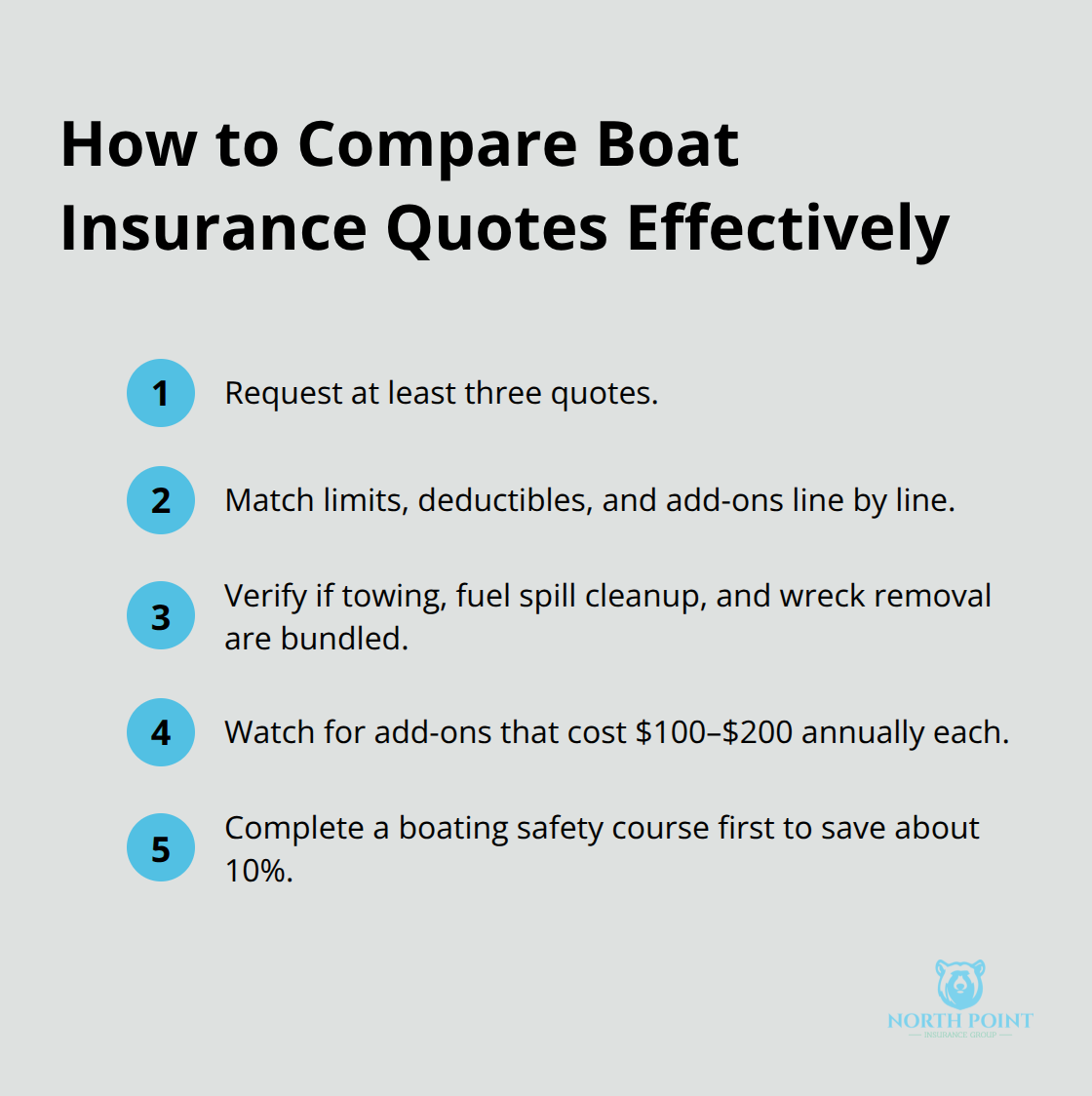
Completing a boating safety course before you shop saves approximately 10% on premiums with most carriers, making a weekend certification worth the investment. When comparing quotes, scrutinize the specific inclusions: does the policy cover fuel spill cleanup, wreck removal, and emergency towing, or do you need to add these riders separately? Some carriers bundle these protections while others charge $100 to $200 annually for each add-on.
Deductibles and Hurricane Coverage Shape Your Final Cost
Deductible selection directly compresses your premium; increasing from a 1% deductible to 5% of insured value typically reduces annual costs by 15% to 25%, but you absorb that difference out-of-pocket when claims occur. For a $50,000 boat, a 1% deductible means you pay $500 per claim, while a 5% deductible means you pay $2,500. Run the math based on your financial cushion and claims likelihood.
If you operate in a hurricane zone, confirm that hurricane preparation coverage is included or available; some insurers reimburse 50% of professional haul-out costs up to $1,000 per event when NOAA issues a Named Storm warning, a benefit worth hundreds of dollars when storms approach. Ask explicitly whether the policy covers your specific boat type and the waters where you operate, since some carriers exclude certain high-performance vessels or restrict coverage to inland waterways only.
Final Thoughts
Boat insurance protects your financial security on the water, but only when you select the right boat policy options for your specific situation. Liability coverage shields you from six-figure claims when you damage property or injure someone, while comprehensive and collision protection your vessel from weather, theft, accidents, and collisions. Medical payments and uninsured boater coverage fill critical gaps that many boat owners overlook until disaster strikes.
Your boat policy options ultimately depend on factors you can measure and control. Boat age, length, and value establish your base rate, while your boating experience and claims history determine whether carriers view you as low or high risk. Location matters enormously-hurricane zones cost substantially more to insure than inland lakes, and winter lay-up periods create legitimate opportunities to reduce annual premiums through discounts that many boat owners miss.
We at North Point Insurance Group understand that boat owners need straightforward guidance, not sales pressure. Our independent agents work with you to find coverage that matches your needs and budget, and we’re ready to discuss your boat insurance needs with an agent who listens. Contact us at https://northpointig.com to explore your options today.
The information provided in this blog is for general informational purposes only and does not constitute legal, financial, or insurance advice. Coverage options, terms, and availability may vary. Please consult with a licensed professional for advice specific to your situation. Artificial intelligence may have been used to generate text and images in some blog articles and may contain inacuracies.

