
Boat Coverage Explained: What Your Policy Covers
Boat owners often wonder what their insurance actually covers when something goes wrong on the water. The gap between what you think is protected and what actually is can be expensive.
We at North Point Insurance Group break down boat coverage explained so you understand exactly what your policy includes, what it excludes, and how to pick the right protection for your vessel.
What Your Boat Policy Actually Covers
Hull Coverage Protects Your Watercraft
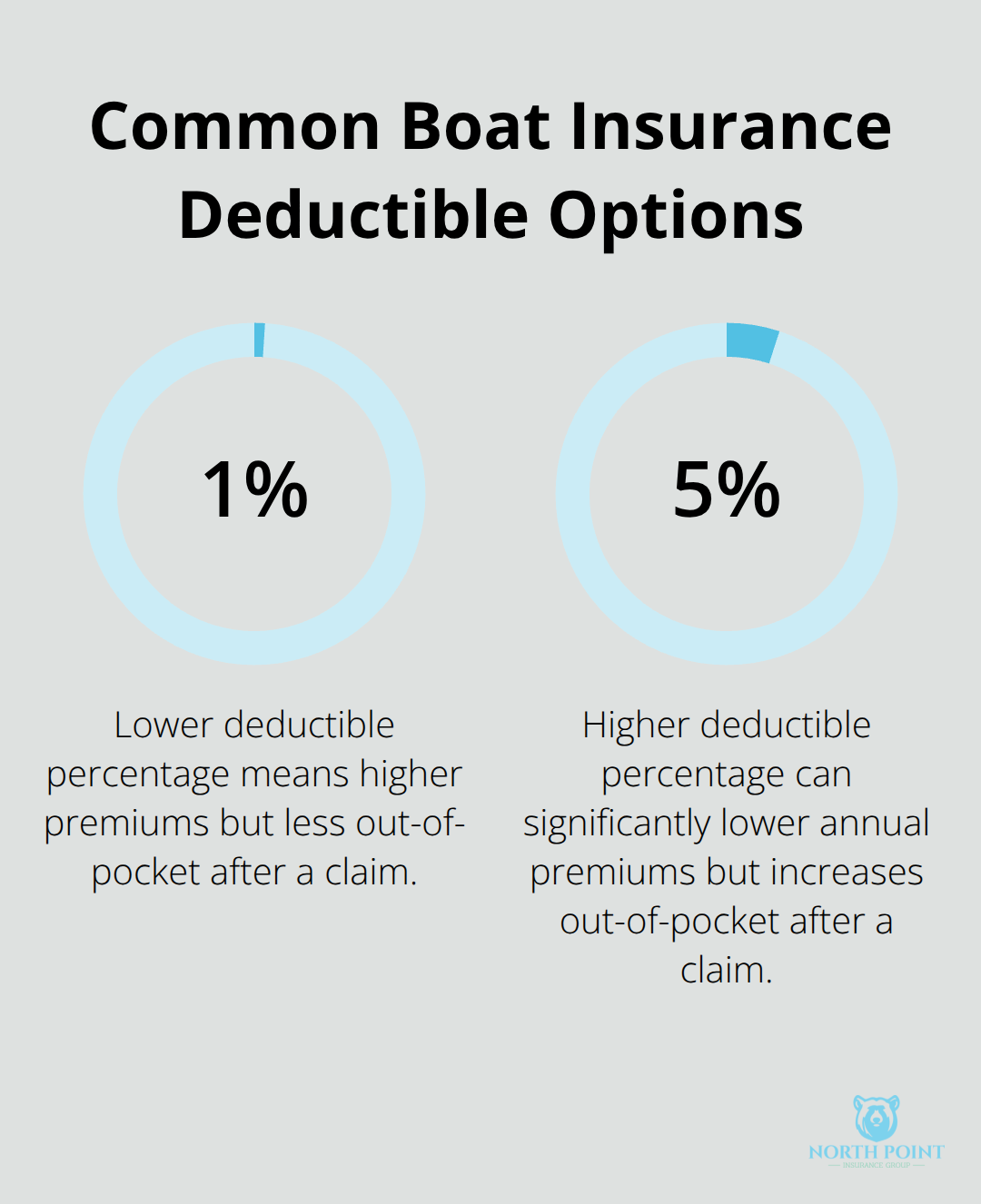
Hull damage coverage repairs or replaces your watercraft after collisions, theft, fire, weather damage, or other covered incidents. Comprehensive coverage handles theft, vandalism, explosions, and weather-related damage like hurricane damage or lightning strikes. Collision coverage pays for damage when you hit another boat, dock, submerged object, or capsize, minus your deductible. The key decision is your deductible amount-increasing it from 1% to 5% of your boat’s insured value can significantly lower your annual premium. If you finance your boat, your lender will require full hull coverage (comprehensive and collision combined with liability), which many lenders call full coverage.
Liability Coverage Protects Other People
Liability coverage protects other people, not your boat, which confuses most boat owners. This coverage pays for injuries you cause to passengers, other boaters, or swimmers, plus damage to docks, pilings, and other boats when you’re legally responsible. Bodily injury and property damage liability covers legal expenses too, so if someone sues you after an accident, your insurer covers defense costs up to your policy limits. Many policies automatically include liability coverage for water sports like tubing, wakeboarding, and waterskiing, though parasailing and being towed through the air typically aren’t covered. Liability also covers fuel spill remediation and wreckage removal when your boat sinks, which can cost thousands of dollars.
Medical Payments and Uninsured Boater Coverage Fill Critical Gaps
Medical payments coverage and uninsured boater coverage address what liability doesn’t protect. Medical payments covers hospital bills and doctor visits for you and your passengers after any accident, regardless of who’s at fault, with no deductible required. This coverage stays separate from your health insurance and pays up to your chosen limit per person. Uninsured or underinsured boater coverage protects you and your passengers if another operator causes an accident but lacks sufficient insurance to pay for your injuries. This matters because many recreational boaters operate without insurance, and you shouldn’t bear the financial burden of their negligence.
Optional Coverages Worth Your Consideration
Your coverage limits matter more than most boat owners realize. A $100,000 liability limit sounds substantial until you face a serious accident involving multiple injured passengers or a collision with an expensive yacht-medical costs and property damage can easily exceed that amount. We recommend reviewing your homeowner’s policy limits alongside your boat policy to avoid gaps in protection. Optional coverages worth considering include total loss replacement, which replaces your totaled boat with a new one if you’re the original owner and the boat is no more than one model year old, or reimburses your original purchase price within five years. Propulsion Plus mechanical breakdown coverage starts around $38 per year and covers lower unit repairs on outboards and upper and lower unit repairs on inboard or outboard motors, even for wear-and-tear damage that standard collision won’t pay for. Understanding these options positions you to make informed decisions about which protections align with how you actually use your boat.
How Boat Insurance Payouts Work When You Need Them
Agreed Value vs. Actual Cash Value: The Payout Difference
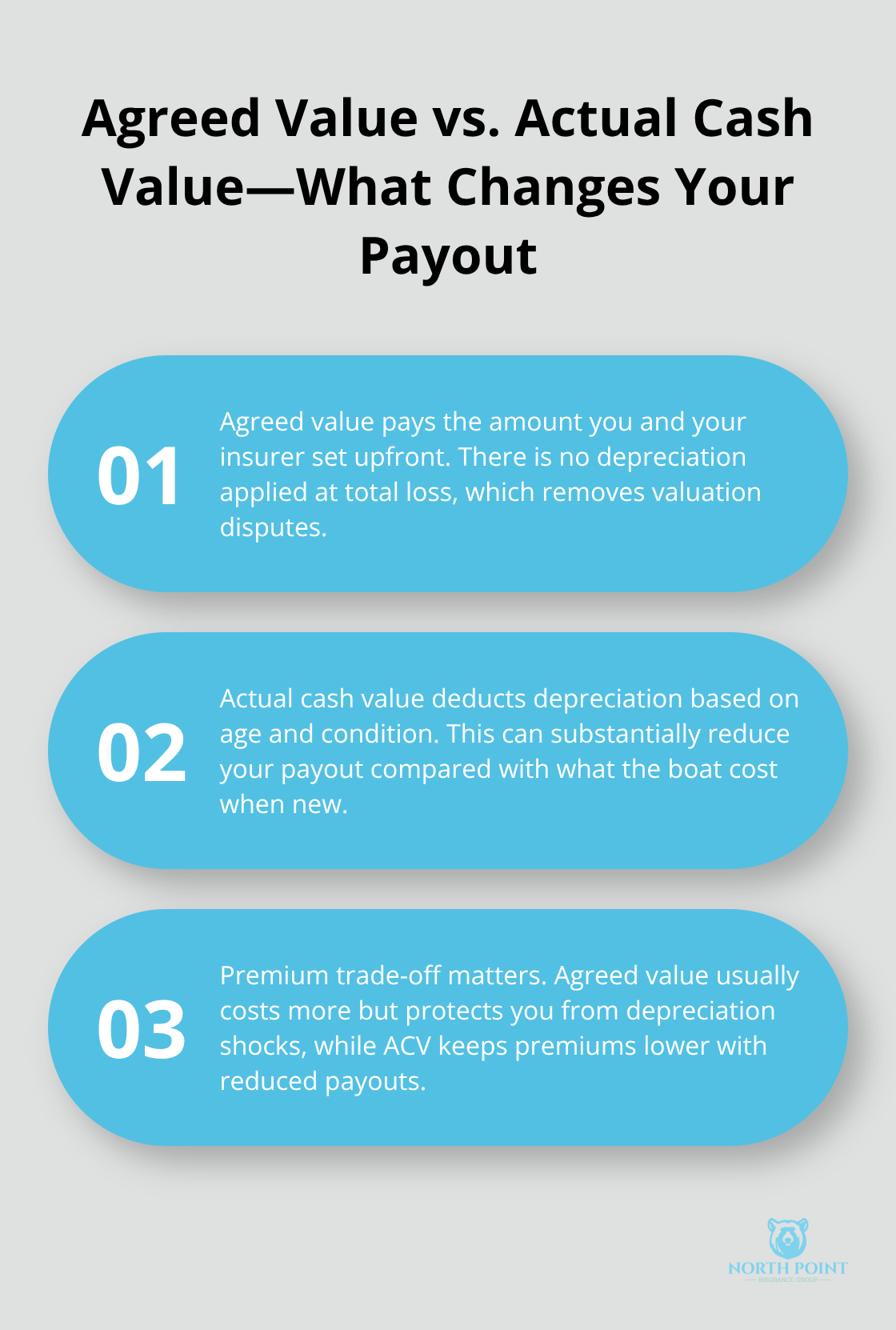
The way your insurer calculates what they’ll actually pay you after a total loss separates good boat policies from ones that leave you short. Agreed value and actual cash value represent two fundamentally different approaches, and the difference can amount to thousands of dollars. With agreed value coverage, you and your insurer settle on your boat’s value upfront, usually supported by a recent marine survey or appraisal. When your boat is totaled, the insurer pays that agreed amount without depreciation-no haggling, no disputes about what your boat was worth on the day it sank. Actual cash value works differently. The insurer calculates your boat’s current market value, subtracts depreciation based on age and condition, then pays you that reduced amount. A five-year-old boat worth $50,000 when new might only be worth $28,000 in actual cash value terms, meaning you pocket $28,000 after a total loss instead of the full agreed value. Agreed value costs more in premiums, but it eliminates the financial shock of depreciation hitting you when you need the money most.
Choosing Between All-Risk and Named Peril Coverage
All-risk versus named peril policies determine whether your coverage is broad or narrow. All-risk policies (sometimes called comprehensive) cover damage from virtually anything unless specifically excluded-theft, fire, weather, vandalism, collisions, and more. Named peril policies only cover the specific perils listed in your contract, which typically includes collision, fire, theft, and weather but excludes many other damage types. The practical reality is that all-risk comprehensive coverage protects you far better, especially in coastal areas where hurricane season and unexpected weather damage your boat regularly. If your boat is newer or financed, agreed value combined with all-risk coverage makes sense. For older vessels or boats you own outright and can afford to replace at market rates, actual cash value keeps premiums lower while named peril coverage still provides basic protection.
Trailer Coverage and On-Water Towing Services
Trailer and towing coverage rounds out your protection by extending beyond the water itself. If your boat’s disabled on the water, on-water towing services cover jump starts, soft un-groundings, and fuel delivery, priced affordably at around $30 to $50 annually depending on your state. Roadside assistance through trailer coverage tows your disabled vehicle or trailer to the nearest repair shop if something fails during transport to the marina. These services address real gaps that standard hull and liability policies leave uncovered.
Total Loss Replacement and Specialized Options
Total loss replacement coverage, available from many carriers, replaces a totaled boat with a new one if you’re the original owner and the boat is no more than one model year old, or reimburses your original purchase price if the boat is within five model years. This option matters most for newer boat owners who want protection against the steep depreciation hit that comes with a total loss. Understanding how your policy calculates payouts and what specialized coverages address your specific boating habits positions you to make informed decisions about protection. The next step involves identifying which exclusions actually matter for your vessel and how to avoid coverage gaps that could cost you thousands.
What Your Boat Insurance Refuses to Pay For
Maintenance and Wear-and-Tear Damage Stay Your Responsibility
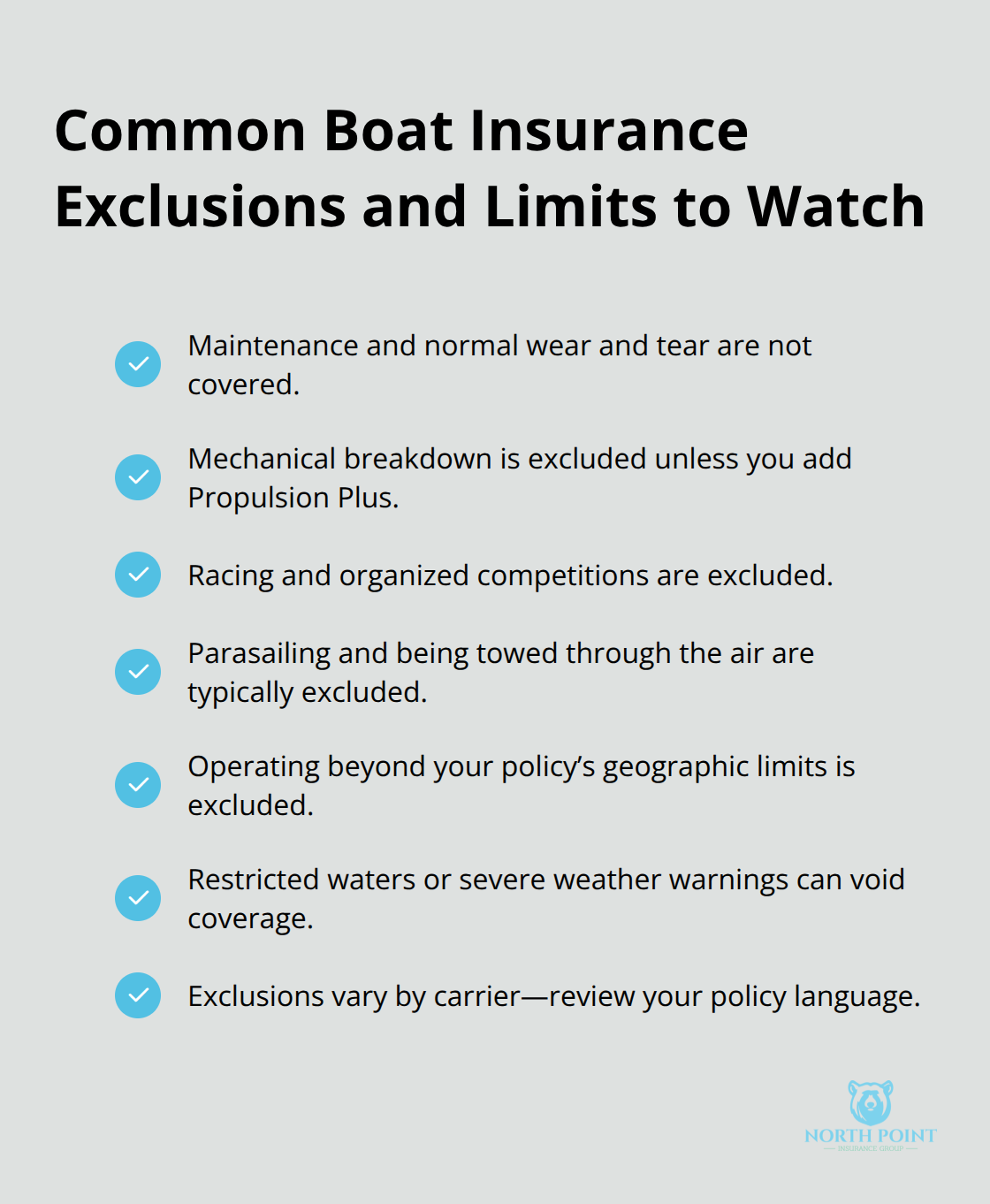
Standard boat insurance explicitly excludes maintenance and general wear and tear, which catches many owners off guard when they file claims. If your engine fails from age and use, your policy won’t cover repairs. If your hull develops osmotic blistering from years of water exposure, that’s your responsibility. Gradual weathering, insect damage, mold, and damage from marine life fall outside coverage boundaries. The practical implication is clear: boat insurance protects against sudden, accidental events, not the slow deterioration that comes with ownership.
Mechanical Breakdown Requires a Separate Add-On
Your policy also won’t cover normal mechanical breakdown unless you’ve purchased Propulsion Plus coverage. Without that add-on, a failed transmission, corroded electrical system, or worn-out water pump leaves you paying full repair costs out of pocket. Many boat owners assume comprehensive and collision coverage handles everything mechanical, then face unexpected repair bills that insurance refuses to touch. The distinction matters because it separates what insurance is designed for-protecting you from catastrophic financial loss-from what it isn’t-maintaining your vessel in working condition.
Racing and High-Risk Activities Fall Outside Standard Coverage
Racing, speed contests, and organized boating competitions aren’t covered under standard policies. If you participate in competitive water skiing tournaments or enter your boat in sanctioned races, your regular policy becomes void for those activities. Water sports liability coverage protects passengers injured during tubing, wakeboarding, and waterskiing, but parasailing and being towed through the air typically fall outside that protection. The line between recreational activity and high-risk activity matters tremendously. Taking your boat out for casual water skiing is covered; competing in a professional water skiing event is not.
Geographic Limits and Restricted Waters Create Coverage Gaps
Pleasure cruising in your designated navigation area stays covered, but operating your boat in restricted waters, during severe weather warnings, or beyond your policy’s geographic limits triggers exclusions. Many carriers limit coverage to specific regions (your home port area, for example), and venturing outside those boundaries voids your protection. We at North Point Insurance Group recommend reviewing your actual policy language because exclusions vary significantly between carriers. What one insurer excludes another might cover, and understanding those differences before you need to file a claim prevents costly surprises when something goes wrong on the water.
Final Thoughts
Boat coverage explained comes down to matching your protection to how you actually use your vessel on the water. Hull coverage protects your boat after collisions, theft, or weather damage, while liability coverage protects others when you cause injuries or property damage. Medical payments and uninsured boater coverage fill critical gaps that liability alone leaves exposed, and your choice between agreed value and actual cash value directly impacts what you’ll receive after a total loss.
Your boat’s age, value, and whether you’ve financed it all influence which coverages make financial sense for your situation. Increasing your deductible from 1% to 5% of your boat’s insured value can significantly reduce premiums if you’re comfortable with higher out-of-pocket costs after an accident. Optional coverages like total loss replacement, propulsion breakdown protection, and on-water towing address real gaps in standard policies, while exclusions for wear and tear, mechanical breakdown, racing, and geographic restrictions define what your policy absolutely won’t pay for.
The right policy matches your coverage to your specific boating habits and budget. Contact North Point Insurance Group to discuss your boat insurance needs and get quotes that reflect your actual risk profile on the water.
The information provided in this blog is for general informational purposes only and does not constitute legal, financial, or insurance advice. Coverage options, terms, and availability may vary. Please consult with a licensed professional for advice specific to your situation. Artificial intelligence may have been used to generate text and images in some blog articles and may contain inacuracies.

