
Watercraft Insurance Essentials: Protecting Your Boat and Crew
Boat owners face real financial risks on the water. From hull damage during storms to liability claims after an accident, the costs add up fast.
At North Point Insurance Group, we know that watercraft insurance essentials go beyond basic coverage. The right policy protects both your investment and the people aboard your vessel.
What Your Watercraft Insurance Actually Covers
Watercraft insurance splits into three critical protection zones, and understanding each one matters because gaps in coverage can leave you exposed to devastating costs.
Hull and Structural Damage: Your Primary Financial Shield
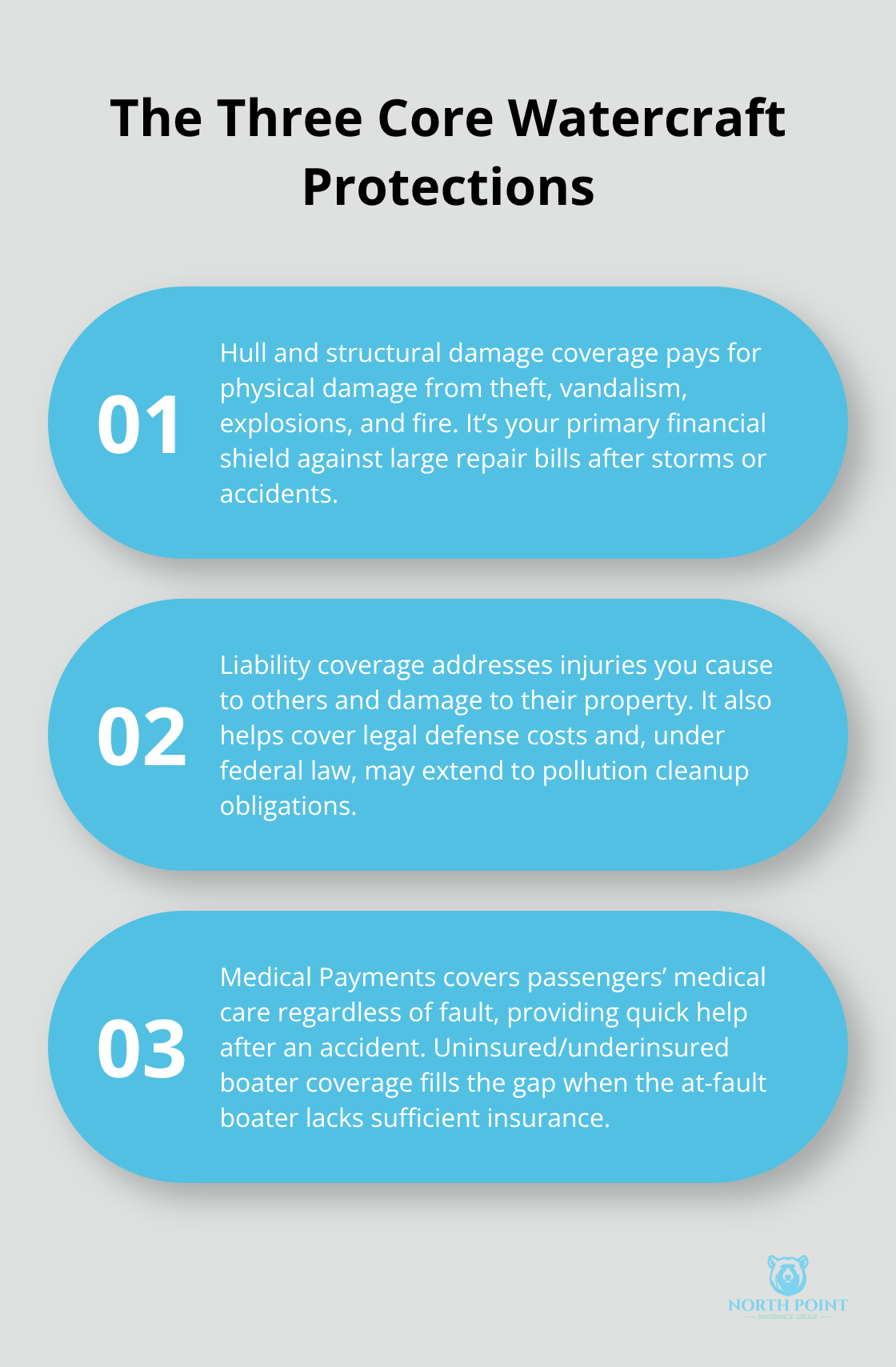
Hull and structural damage coverage protects your watercraft against damages from events outside of your control, including theft and vandalism, explosions, and fire. This is your primary financial shield against the biggest risks on the water. The average annual premium for recreational boats runs between $300 and $600 according to industry data, but that cost reflects the real value of protection; boats valued at $50,000 can face tens of thousands in repair bills from a single storm or accident.
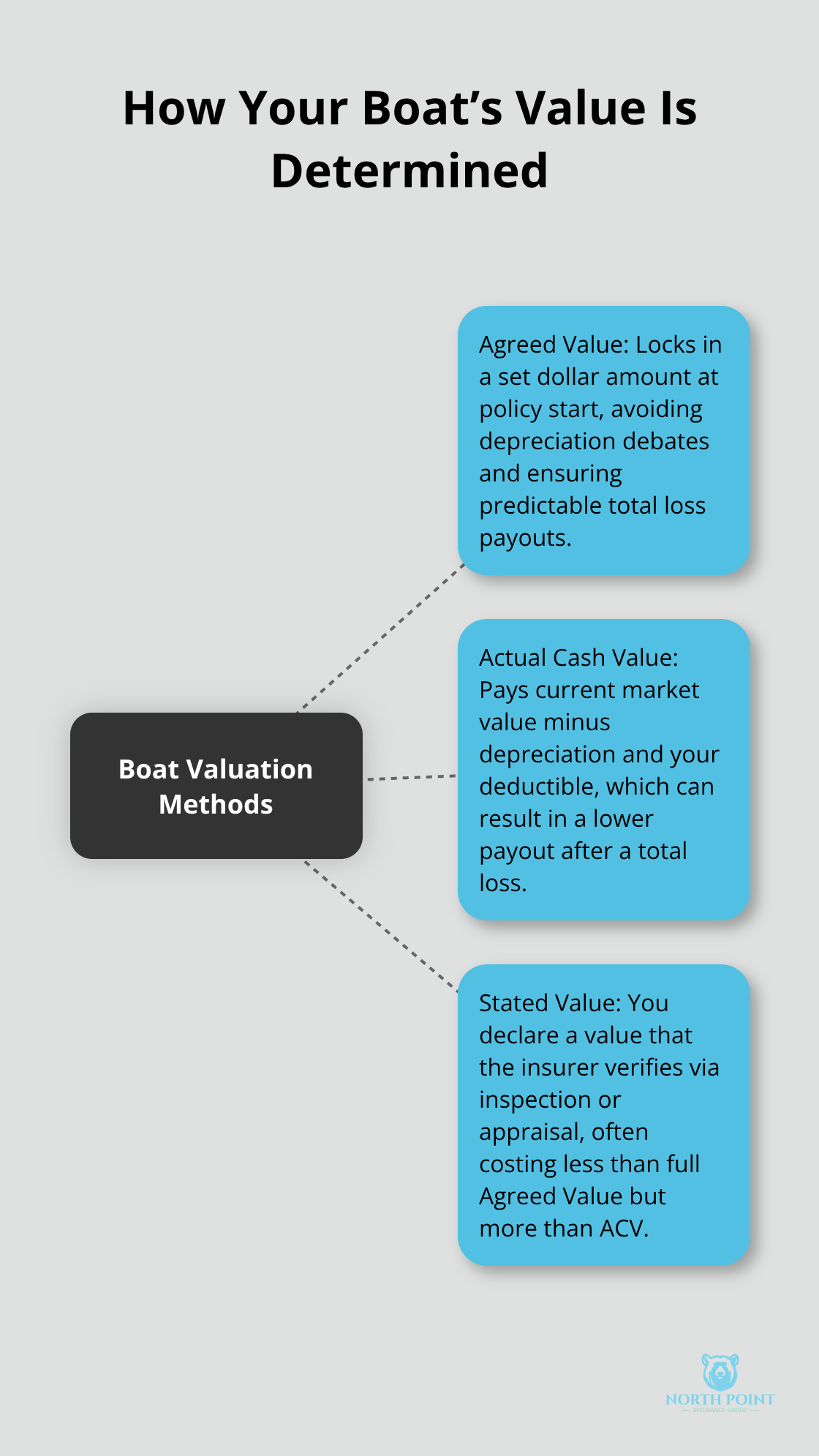
You have two main valuation approaches. Agreed Value coverage locks in a set dollar amount at policy start, so you receive that full amount for total losses without depreciation arguments. Actual Cash Value policies pay based on current market value minus depreciation and your deductible. Agreed Value is stronger if you own a boat that holds its value or if you want certainty about payouts, but it costs slightly more upfront.
Your deductible typically ranges from 1% to 5% of your boat’s insured value. Choosing a higher deductible directly lowers your premium-a strategic trade-off worth calculating based on your financial comfort with out-of-pocket costs.
Liability Protection Separates You From Financial Ruin
Liability coverage handles two distinct threats. Bodily Injury Liability covers medical expenses, lost wages, and legal fees if someone aboard another boat or on property gets injured because of your actions. Property Damage Liability pays for damage to other boats, docks, or structures you cause.
This coverage is non-negotiable because a single serious injury claim can exceed $100,000 in medical costs alone, and legal defense fees stack up fast. Many states don’t legally require boat liability insurance, but lenders almost always do, and marinas frequently mandate it as a condition of mooring. Under the Oil Pollution Act of 1990, your liability coverage extends to pollution cleanup costs up to $939,800 if your boat spills fuel or creates environmental damage.
Medical Payments and Uninsured Boater Coverage
Medical Payments coverage operates separately and covers your passengers’ medical care after an accident regardless of fault. This protects your crew and passengers without requiring them to sue you. Uninsured or underinsured boater coverage activates when another boater causes an accident but lacks sufficient insurance to cover your damages; this fills a critical gap because many boat owners carry minimal or no liability coverage.
Set your liability limits based on your actual assets and net worth. If you have $500,000 in savings and property, carrying only $100,000 in liability coverage leaves you vulnerable to personal lawsuits that could take everything. The next step involves comparing how different policies value your boat and what deductibles make sense for your situation.
Types of Watercraft Insurance Policies
Agreed Value vs. Actual Cash Value: Which Protects Your Investment
The valuation method you select determines exactly what you receive when your boat sustains damage or faces a total loss, and this decision matters far more than most boat owners realize. Agreed Value coverage locks in a specific dollar amount at policy inception, meaning you receive that exact figure for total losses without any depreciation deduction. This approach eliminates disputes about your boat’s current market value, which is critical because boat markets fluctuate significantly. Actual Cash Value policies calculate payouts based on current market value minus depreciation and your deductible, so a total loss could net you substantially less.
For newer vessels purchased within the last five years, Agreed Value typically makes financial sense because your boat retains most of its value and you avoid depreciation arguments with insurers. The trade-off is straightforward: you pay more upfront for certainty about what you’ll receive in a claim.
Stated Value Policies for Mid-Range Boats
Stated Value policies occupy a middle ground between Agreed Value and Actual Cash Value. You declare your boat’s value, but the insurer verifies that amount through inspection or appraisal. This approach costs less than full Agreed Value but more than Actual Cash Value, making it practical for mid-range boats where precise valuation matters but absolute certainty feels less critical.
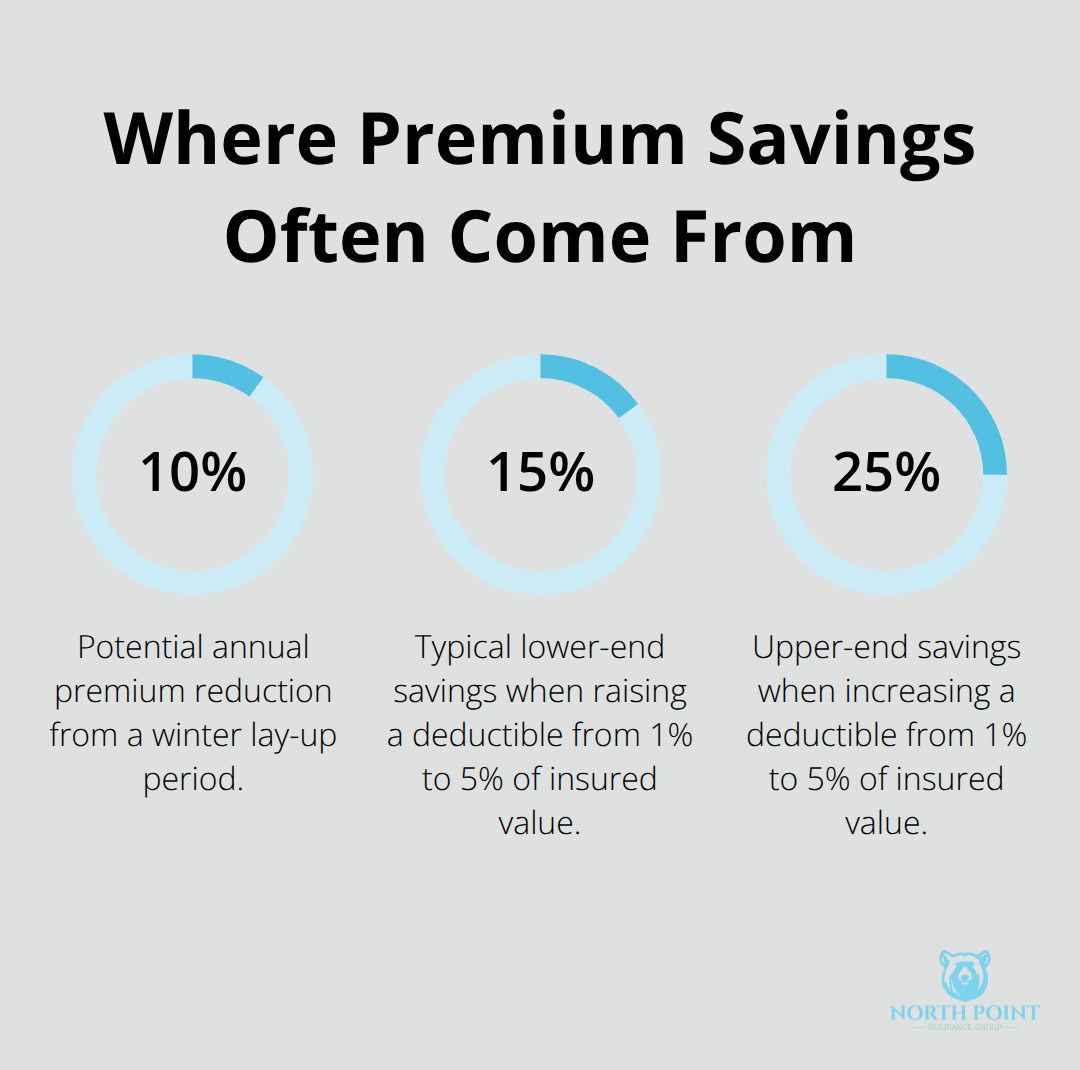
Your deductible selection directly impacts your annual premium-raising your deductible from 1% to 5% of insured value can reduce yearly costs by 15% to 25% according to marine insurance specialists. This strategy only works if you can comfortably absorb the higher out-of-pocket expense during a claim.
Specialized Coverage for Fishing Boats and Rental Vessels
Fishing boats and rental vessels present different considerations entirely. Fishing boats operate in harsh saltwater environments that accelerate wear, corrosion, and equipment degradation, so insurers often apply steeper depreciation schedules under Actual Cash Value policies. Rental vessels face higher claim frequency because multiple operators create increased accident risk, meaning insurers price Agreed Value coverage at premiums that can offset the valuation certainty benefit.
For rental operations specifically, you should document your boat’s condition annually with professional surveys because insurers increasingly require updated marine surveys before renewing coverage on vessels used commercially. The navigation area you declare also shapes which policy structure makes sense-limiting your coverage to freshwater inland lakes costs significantly less than blue-water cruising policies that extend to the Caribbean or offshore routes, so be honest about your actual usage patterns rather than purchasing coverage for trips you rarely take.
Personal Effects and Emergency Assistance Add Real Value
Personal effects coverage protects fishing gear, electronics, safety equipment, and personal belongings while aboard your vessel. This coverage typically carries its own deductible and annual limits, and items like high-end fish finders, GPS units, and specialized tackle depreciate quickly, making Agreed Value selection more valuable here than on the hull itself.
Emergency towing and assistance coverage rounds out the policy structure-this endorsement reimburses towing costs if your boat becomes disabled, fuel or oil delivery charges, and emergency labor. Some insurers cap annual towing claims while others offer unlimited incidents, so review this detail carefully if you frequently operate in remote areas or poor weather conditions where mechanical failure becomes more likely.
The specific coverage limits you select, combined with your deductible choice and valuation method, create a policy that either protects you adequately or leaves gaps that cost money when you need it most. Your next decision involves comparing how different carriers structure these options and what additional protections matter most for your actual boating patterns.
How to Choose Watercraft Insurance That Matches Your Actual Boat
Selecting watercraft insurance requires matching coverage to three concrete factors: what your boat is worth right now, how you actually use it, and which protection gaps would hurt most financially. Start by collecting your boat’s exact specifications-year, make, model, hull identification number, engine horsepower, and current market value. Don’t guess at valuation; check recent sales of comparable boats in your area or request a professional marine survey if your boat exceeds $50,000 in value. This data becomes your foundation for every quote you request.
Document your usage patterns honestly. Do you cruise inland lakes only, or do you venture to coastal areas? Do you fish commercially or recreationally? Will you operate the boat year-round or lay it up for winter months? Insurers price policies dramatically differently based on navigation area-freshwater inland coverage costs substantially less than blue-water policies extending to the Caribbean or offshore routes. If you overstate your cruising area, you’ll overpay for coverage you don’t need; if you understate it, claims get denied when you operate outside your declared zone.
A lay-up period during winter months can reduce your annual premium by 10% to 15% according to marine insurance specialists. If your boat sits idle during hurricane season or freezing months, declare that explicitly to your insurer.
Comparing Deductibles and Coverage Limits Across Carriers
Different carriers structure their deductible options in ways that significantly impact your annual cost. Most offer deductibles ranging from 1% to 5% of your boat’s insured value, but some carriers allow flat-dollar deductibles like $500 or $1,000 instead. Run the math on your specific boat: if your vessel is valued at $75,000, a 1% deductible equals $750 out-of-pocket, while a 5% deductible means $3,750 in your pocket during a claim.
Raising that deductible from 1% to 5% typically reduces your annual premium by 15% to 25%, making it a legitimate strategy if you maintain an emergency fund. However, this only works if you can genuinely absorb that higher expense without financial stress.
When comparing liability limits across carriers, don’t default to minimum coverage. Standard liability limits start at $100,000 per occurrence, but serious injury claims regularly exceed that amount-a single severe spinal cord injury can generate $250,000 to $500,000 in medical expenses and legal fees. If you have significant personal assets, carrying $300,000 to $500,000 in liability coverage protects what you’ve built.
Request quotes with identical coverage parameters from at least three carriers so you’re comparing apples to apples. GEICO Marine Insurance and Progressive both offer online quote tools that let you input your boat details and receive instant estimates, while specialized carriers like Chubb focus on higher-value vessels.
Emergency Services and Specialized Endorsements
Emergency towing and assistance coverage separates insurers who understand boating realities from those offering generic marine policies. TowBoatUS covers towing costs when your boat becomes disabled, fuel or oil delivery, and emergency labor-but verify whether the policy caps annual claims at $500 or $1,000 versus offering unlimited incidents. If you frequently operate in remote areas or rough weather conditions where mechanical failure becomes likely, unlimited towing coverage justifies the modest premium increase.
Personal effects coverage also deserves scrutiny because fishing gear, GPS units, and electronics depreciate rapidly. Some carriers apply 10% annual depreciation to electronics, meaning a $2,000 fish finder might only pay $1,200 after three years of ownership. Agreed Value coverage on personal effects protects against this depreciation trap.
Specialized Coverage for Commercial and Fishing Operations
For fishing boats specifically, request coverage that explicitly includes tackle, rods, and specialized equipment-not all policies cover these items automatically. If you operate your boat commercially for charter or fishing guide services, standard recreational policies exclude that usage entirely. You’ll need a commercial endorsement or separate policy, and insurers increasingly require updated marine surveys before renewing coverage on vessels used commercially.
Getting Clear Quote Breakdowns
Get a detailed quote breakdown showing exactly which coverages have which limits and deductibles, then ask your agent which exclusions apply and which endorsements you can add. This clarity prevents claim denials months later when you discover your policy didn’t cover your actual usage. An independent agent who shops multiple carriers can help you compare options side-by-side and identify which endorsements make sense for your specific boat and boating patterns.
Final Thoughts
Watercraft insurance essentials protect both your financial investment and the people aboard your vessel, while inadequate coverage exposes you to catastrophic losses that can devastate your finances. The decisions you make about valuation method, deductible levels, and liability limits determine whether a claim pays out fully or leaves you fighting with your insurer while facing unexpected expenses. Your boat’s actual usage patterns should drive every coverage decision you make, since a freshwater inland cruiser needs different protection than a saltwater fishing vessel operating offshore.
Raising your deductible from 1% to 5% of insured value reduces annual premiums by 15% to 25%, but only if you can absorb that higher out-of-pocket expense during a claim. Selecting Agreed Value coverage costs more upfront but eliminates depreciation disputes when your boat sustains damage, making it the stronger choice for newer vessels where valuation certainty matters most. Honest documentation of where you boat, how often you operate, and what equipment matters most prevents claim denials months later when you discover your policy didn’t cover your actual situation.
Gather your boat’s specifications, document your usage patterns honestly, and request detailed quotes from multiple carriers with identical coverage parameters to reveal which insurers understand boating realities. Contact North Point Insurance Group to discuss your specific boat and boating needs, and let our agents help you build protection that actually covers what matters.
The information provided in this blog is for general informational purposes only and does not constitute legal, financial, or insurance advice. Coverage options, terms, and availability may vary. Please consult with a licensed professional for advice specific to your situation. Artificial intelligence may have been used to generate text and images in some blog articles and may contain inacuracies.

